This article has been reviewed according to Science X's editorial process and policies. Editors have highlighted the following attributes while ensuring the content's credibility:
Respiratory disease in children is a major global concern. Clinicians traditionally rely on stethoscopes to detect abnormal lung sounds, but access to auscultation can be limited by the need for in-person visits.
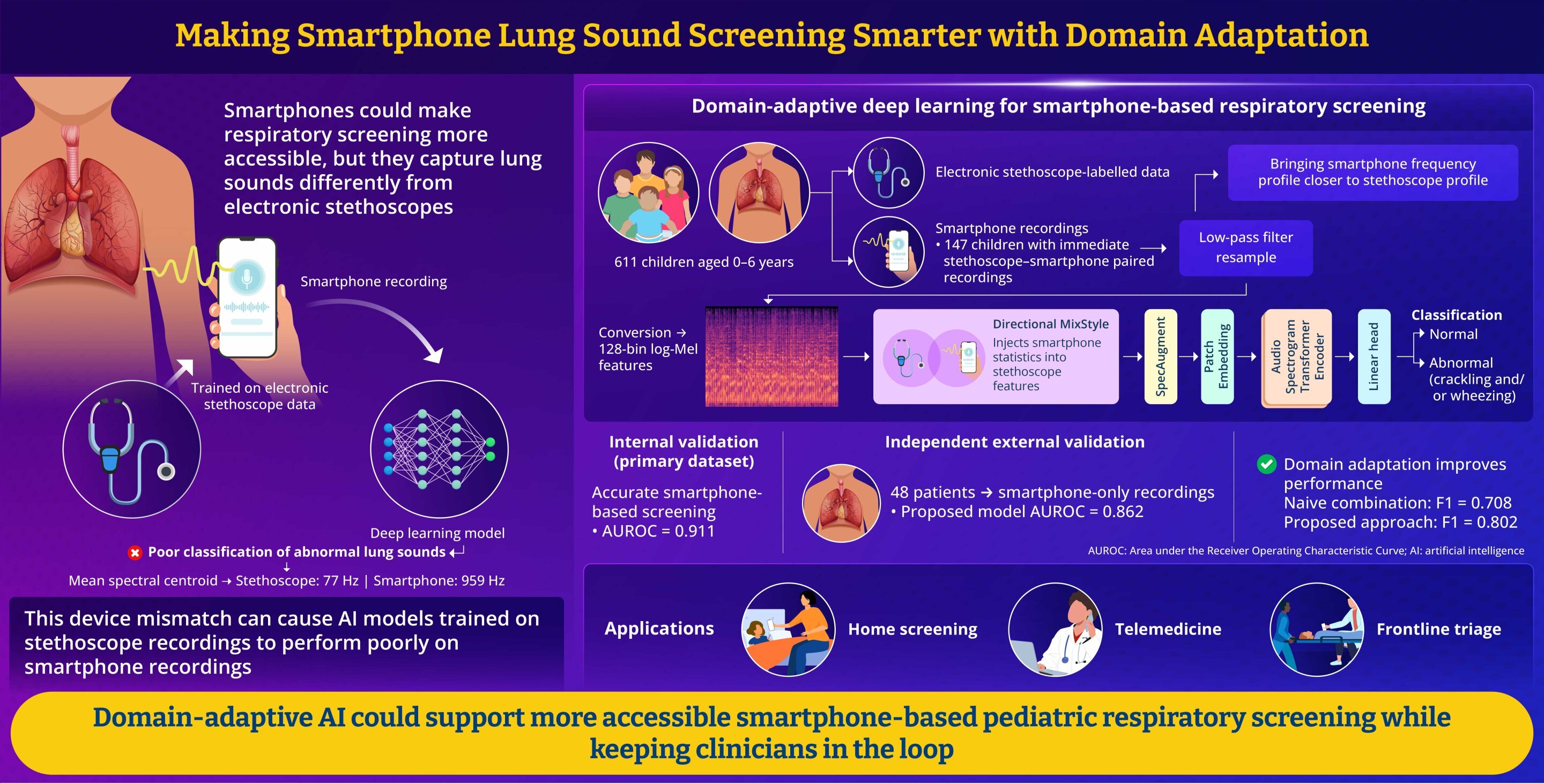
Smartphones, with their built-in microphones and widespread availability, could support home-based respiratory screening. However, applying AI models trained on electronic stethoscope recordings to smartphone audio remains challenging because of a substantial domain mismatch caused by differences in how the devices capture sound.
To address this mismatch, a research team in the Department of Applied Artificial Intelligence at Seoul National University of Science and Technology in South Korea has developed a domain-adaptive deep learning framework specifically designed for smartphone deployment. The team is led by associate professor Seong-Eun Kim and includes first author Seunggyu Jeong, a doctoral student.
"To a neural network, the smartphone and electronic stethoscope effectively speak different languages," explains Kim. "Instead of simply pooling the data from the two devices, our approach offers reliable domain adaptation, where the model learns from reliable labeled electronic stethoscope recordings while adapting to the smartphone domain."
Their study is published in the IEEE Journal of Biomedical and Health Informatics.
The researchers first collected paired stethoscope-smartphone recordings. For the primary data set, they acquired electronic stethoscope lung sound recordings for 611 children, ages 0–6. Of these, 147 also provided paired smartphone recordings. With both devices, lung sounds were recorded at the same four anatomical sites.
Source link