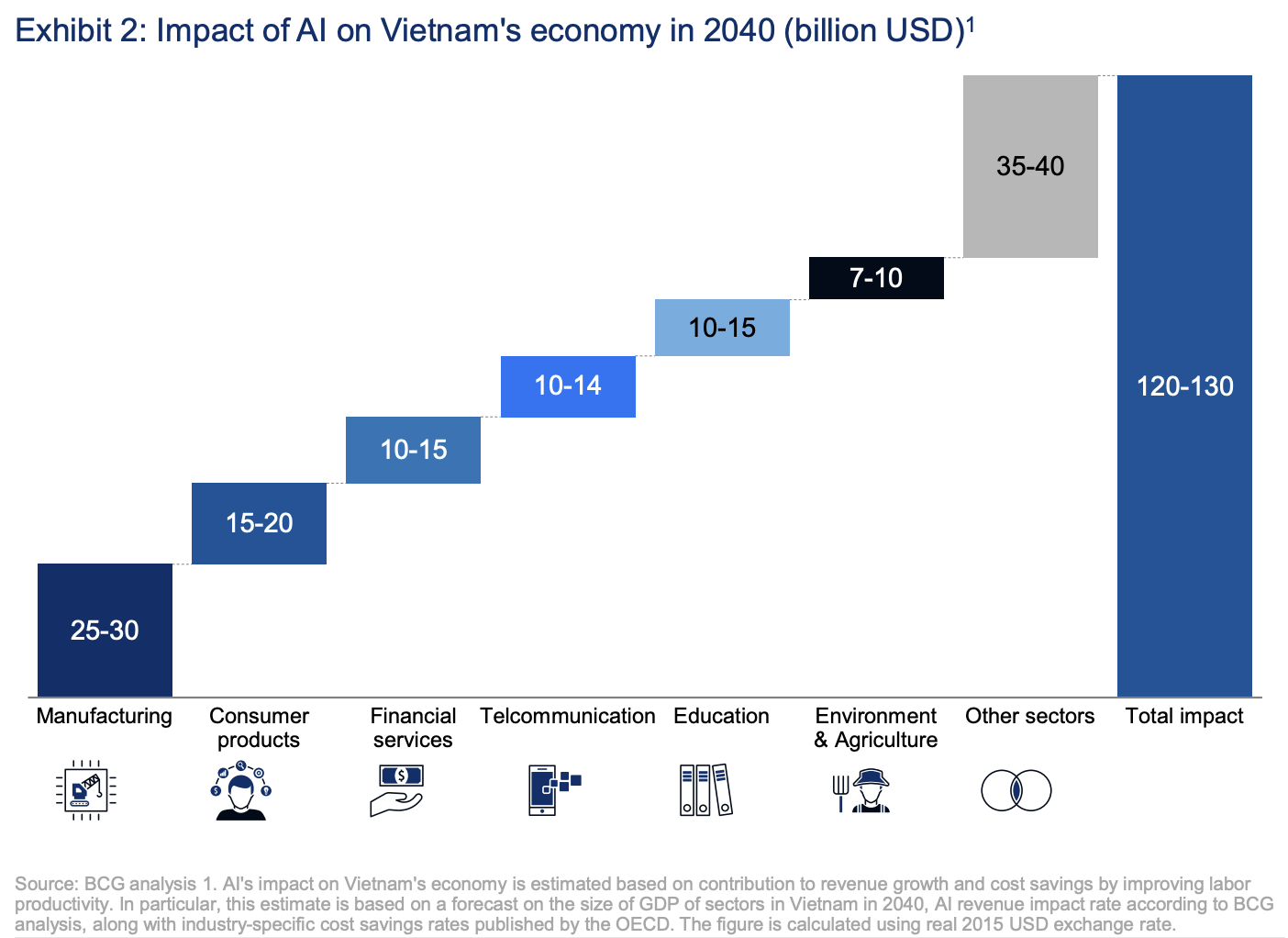
The artificial intelligence (AI) economy in Vietnam is projected to reach between US$120 billion and 130 billion by 2040.
This remarkable growth attributed to a significant boost in productivity and a surge in consumption-driven revenue, according a new report by the Vietnam National Innovation Centre (NIC), the Japan International Cooperation Agency (JICA), and Boston Consulting Group (BCG).
By 2040, AI is poised to contribute up to US$130 billion to the domestic economy. This contribution will include a growth in consumption-driven revenue, which is set to generate US$45 billion to US$55 billion by then, fueled by increasing demand for AI-powered products and services, and productivity-driven cost savings, which are set to amount to US$60 billion to US$75 billion, achieved through AI-enabled automation, predictive analytics, and efficiency enhancements.
The impact of AI is expected to be felt across all major industries in Vietnam. The technology is set to contribute between US$25 billion and US$30 billion in manufacturing by 2040, and US$15 billion and US$20 billion in consumer products. The financial services sector is expected to benefit from US$10 billion and US$15 billion, while education will receive between US$10 billion and US$15 billion.
Over the past years, Vietnam has made meaningful progress in AI adoption. In the private sector, AI has gradually been expanded since 2019, especially in banking, logistics, consumer, and healthcare.
The banking industry was an early adopter of the technology, leveraging AI for facial recognition, electronic know-your-customer (eKYC) processes, optical character recognition (OCR), and voice bots. Notably, Techcombank uses AI and machine learning (ML) to provide personalized financial management advice and insights, leveraging the technology to deliver over 100 million personalized insights views in 2023.
Source link