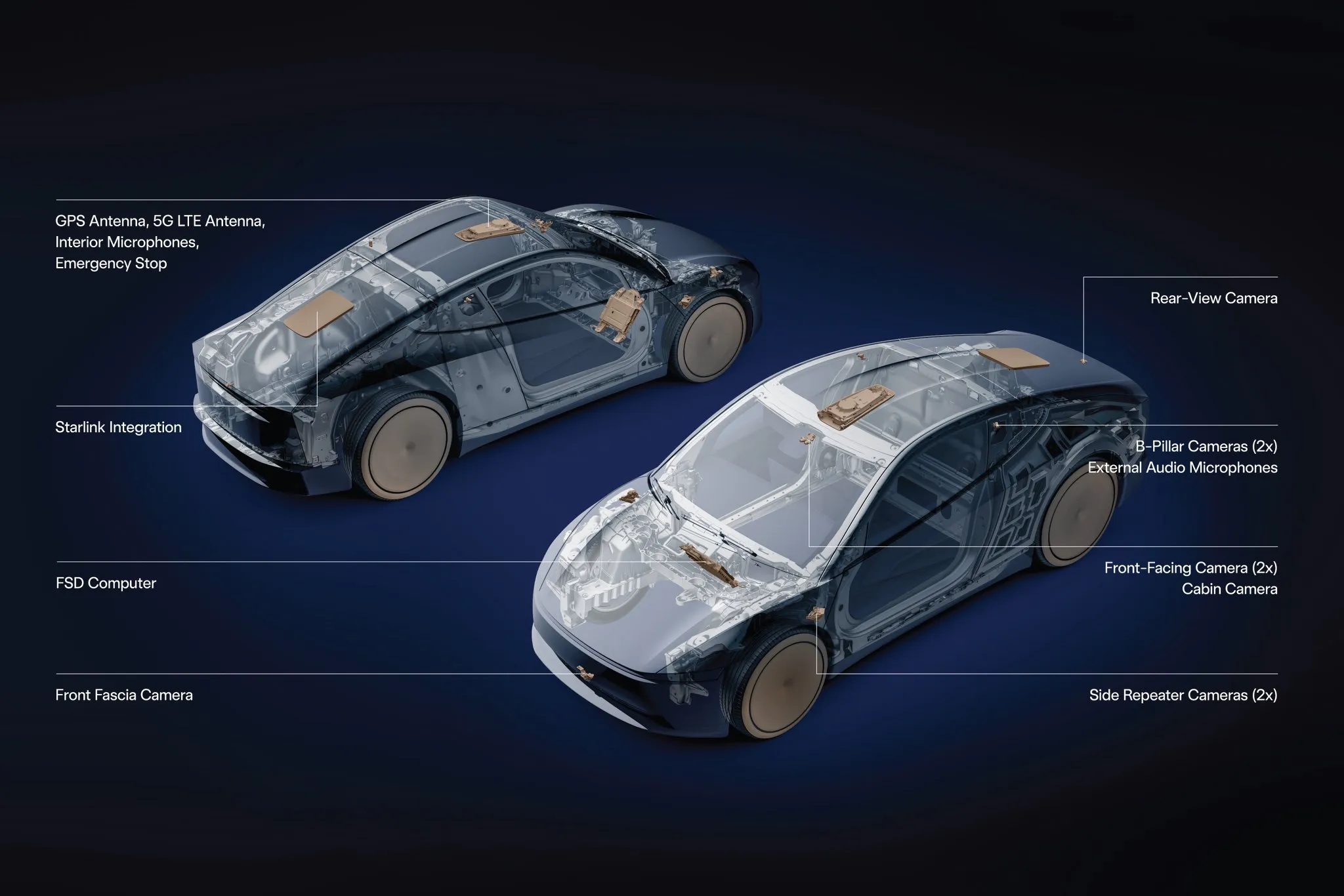
Tesla built the Cybercab’s battery pack with empty space inside it on purpose, and the reason points to a cheaper robotaxi down the road.
Robert Sumpf, Tesla’s director of mechanical design engineering for battery modules and packs, said the extra room beside and beneath the Cybercab’s modules was left there so the company can move to lithium iron phosphate cells later. “So, we protected this pack to go to an even lower energy dense chemistry as we scale and need to bring LFP into the platform,” Sumpf said in a Cybercab deep dive with Munro Live.
The Cybercab runs on Tesla’s own 4680 cells with a nickel chemistry today. LFP cells store less energy for their size, so a straight swap would cut range. The reserved space lets Tesla add more LFP cells to make up the difference. In return, Tesla would get cells that cost less, run cooler and survive more charge cycles. LFP became the most used EV battery chemistry in the world last year.
Not all of that room was planned for a chemistry change. Lars Moravy, Tesla’s Vice President of Vehicle Engineering, said part of it exists because “we didn’t need as many batteries as we thought we did.” Tesla told Sandy Munro in early 2025 that it was targeting a Cybercab pack under 50 kWh with close to 300 miles of range.
The pack also breaks from the structural design Tesla used in some Model Y and Cybertruck builds. Instead of potting hundreds of cells into one block, the Cybercab uses four separate, individually sealed modules, so a bad module can be replaced without scrapping the whole pack.
Source link