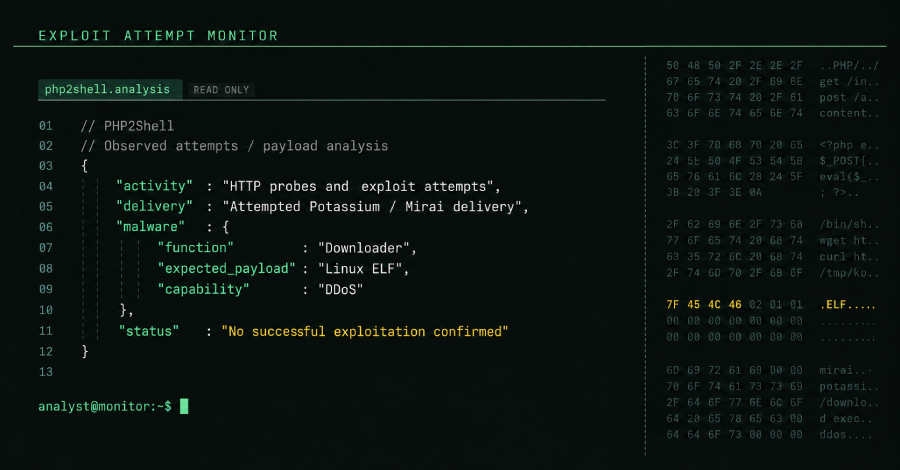
Threat actors have been observed unsuccessfully attempting to exploit the newly disclosed PHP2Shell vulnerabilities to rope infected systems into a Mirai botnet variant called Potassium, as it emerges that weaponizing the flaws may be harder than previously thought.
The attacks aim to exploit CVE-2026-109618 and CVE-2026-109619 (CVSS scores: 9.2), which can result in unauthenticated remote code execution (RCE) via specially crafted HTTP requests. The vulnerabilities have been patched in PHP versions 8.5.12, 8.4.27, 8.3.36, and 8.2.35.
"However, analysis of the sample revealed that it is an updated and significantly expanded version of the Mirai-derived botnet variant identified in early 2026," Sophos said. "The sample displays downloader and network disruption functionality."
Specifically, it resolves a hard-coded, encrypted command-and-control (C2) address, establishes a TCP connection to 134.199.154[.]64, and sends an HTTP request. The malware then checks for an HTTP 200 response status and verifies that the resulting payload begins with the ELF magic bytes 7F 45 4C 46, indicating that it expects a Linux ELF binary as a follow-on payload.
"A resolver function supports IPv4 addresses and hostname resolution, with additional fallback resolution logic that includes hard-coded public DNS servers such as 8.8.8.8, 1.1.1.1, and 1.0.0.1," Sophos added. "As with Mirai malware historically, this sample can execute DDoS attacks."
The attacks have been found to originate from the following three IP addresses -
]100 to retrieve a loader, which is responsible for deploying the Mirai botnet variant. ]64, and establish a C2 channel on TCP port 50792.
Source link