This article has been reviewed according to Science X's editorial process and policies. Editors have highlighted the following attributes while ensuring the content's credibility:
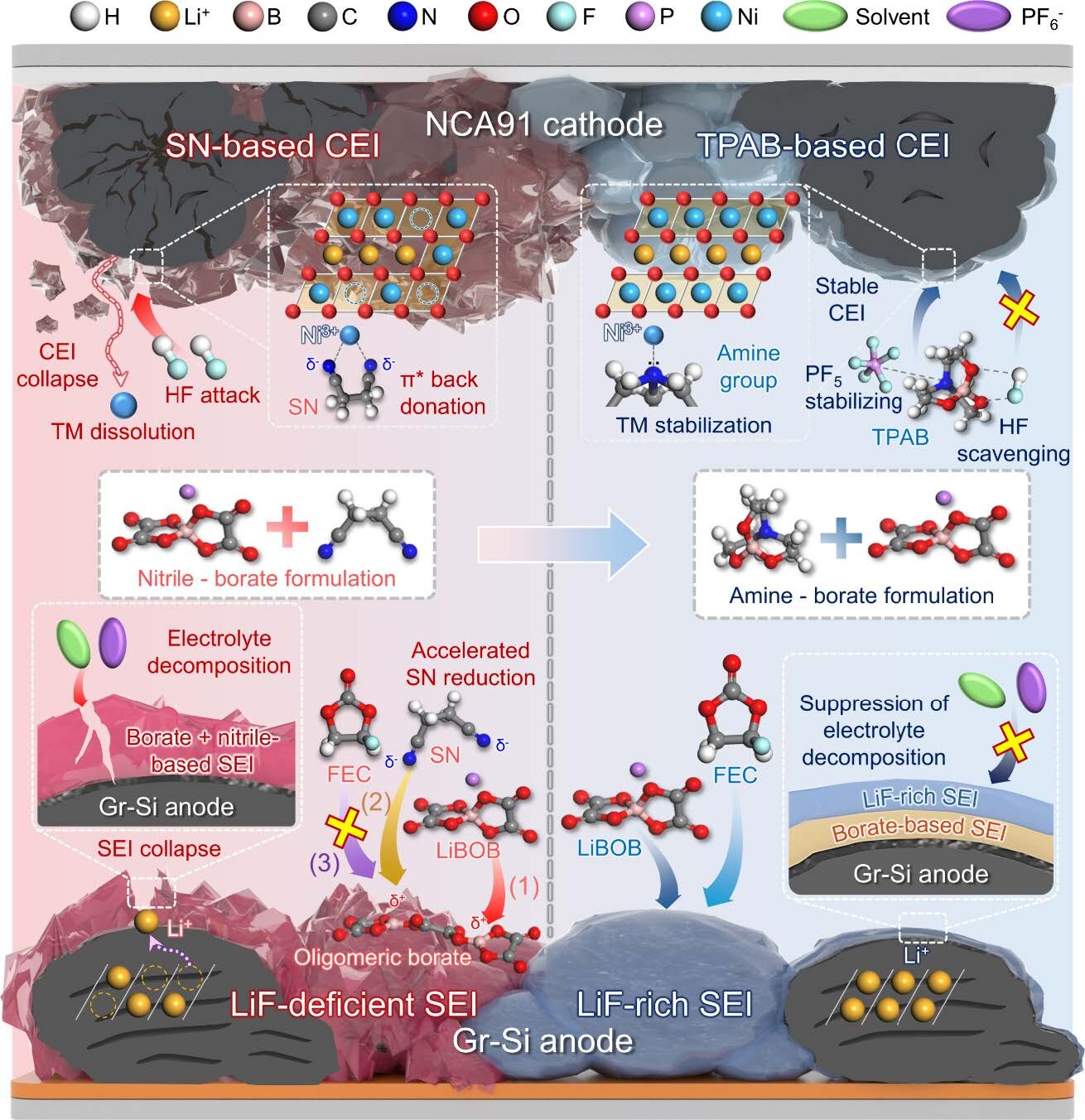
Electrolyte additives designed to improve battery performance can instead shorten battery life when they are incompatible with each other. Researchers at the Korea Advanced Institute of Science and Technology (KAIST) have identified why protective layers inside batteries fail to form properly when certain additives are used together and have proposed a new additive to address this problem. The findings are expected to contribute to the development of electric vehicle (EV) batteries that retain their capacity over long-term use.
A research team led by Professor Nam-Soon Choi from the Department of Chemical and Biomolecular Engineering, in collaboration with Professor Dong-Hwa Seo of the Department of Materials Science and Engineering, has identified the adverse effects of combining conventional electrolyte additives in high-energy lithium-ion batteries and introduced a new additive that improves battery lifespan and stability.
For EV batteries, maintaining performance through repeated charging and discharging is as important as storing a large amount of energy. As capacity declines, the driving range per charge becomes shorter. At high temperatures, unwanted chemical reactions inside the battery occur more readily, which can speed up performance degradation.
Electrolyte additives play an important role in reducing this degradation. The electrolyte allows lithium ions to move between the cathode and anode, the battery's two electrodes, which exchange lithium ions to store and release energy during charging and discharging. Small amounts of additives in the electrolyte form thin protective layers on the electrode surfaces, reducing side reactions and slowing performance degradation.
Source link