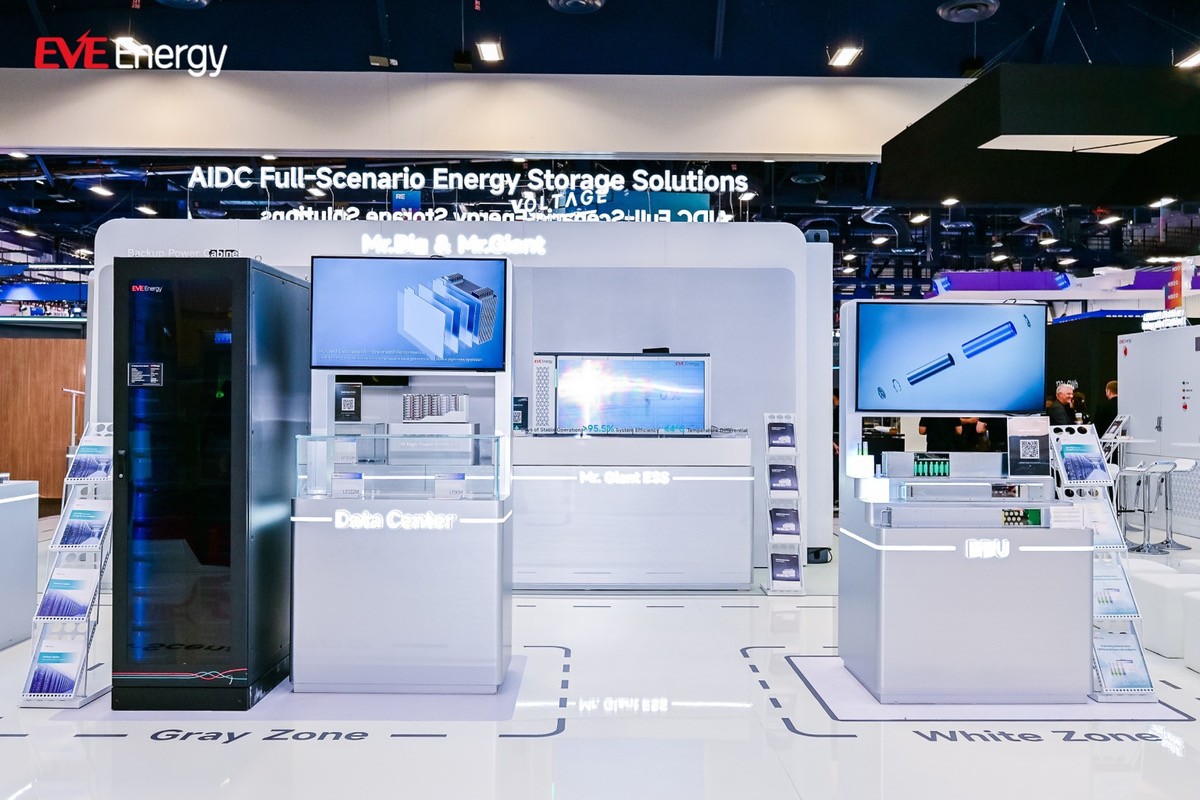
AI data centers are changing the duty cycle expected of battery energy storage. Alongside conventional requirements for backup capacity and renewable-energy integration, operators must manage rapid load changes associated with high-density computing. A single battery architecture is unlikely to meet every requirement efficiently.
The distinction begins with response time. At the source-grid interface, storage can support renewable integration, demand management, and frequency regulation. Within power-distribution systems, batteries must sustain high output during short interruptions. At server-rack level, even shorter fluctuations require millisecond-scale intervention.
EVE Energy structures its AIDC offering around these three layers. For source-grid applications, its 20-foot, 5 MWh high-power storage system is designed for 1P operation and frequent cycling, with 93.6% system efficiency and an operating range of −40°C to 55°C. Its S5-1P system uses dedicated 315 Ah frequency-regulation cells with 395 Wh/L energy density. EVE reports no lithium plating under specified 1P charge-discharge and 1.22P frequency-regulation tests — demonstrating cell stability under demanding high-rate operation.
For longer-duration applications, the Mr.Giant 3.0 system integrates 6.9 MWh in a standard 20-foot container using 702 Ah cells. Published specifications include a 10,000-cycle system life at 70% state of health and a system temperature difference of no more than 5°C. Actual performance depends on operating conditions.
At the distribution layer, EVE’s 6C/10C backup cabinets target high-power, short-duration loads and compatibility with UPS and high-voltage DC architectures. The 10C configuration delivers a specified 660 kW over five minutes. At rack level, its battery backup unit uses 21700 LFP cylindrical cells, supports 15C–30C discharge rates, and specifies switchover within 2 milliseconds.
Source link