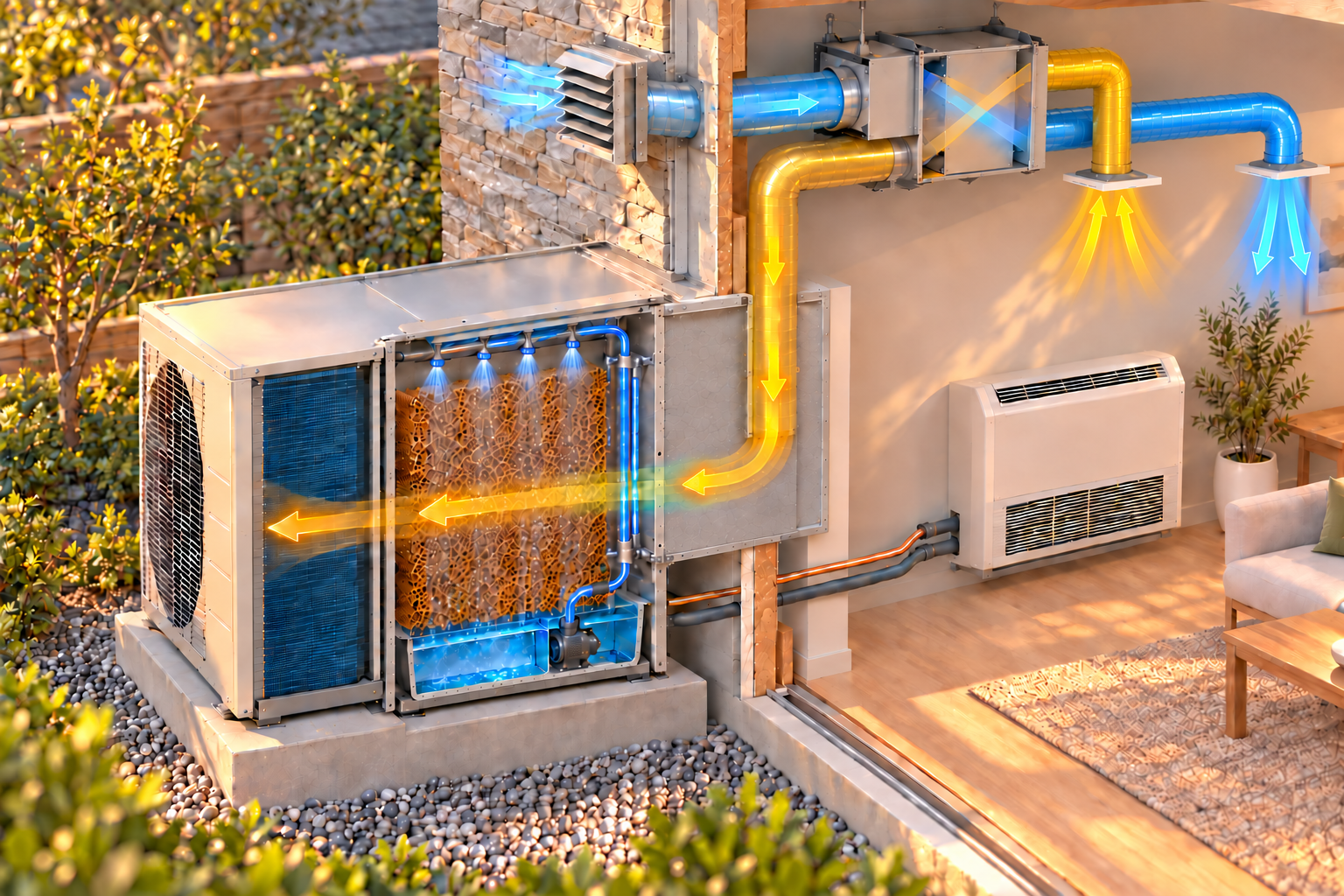
A South Korean research team has proposed a residential air-source heat pump (ASHP) system that combines exhaust air from an energy recovery ventilator (ERV) with direct evaporative cooling. Tests showed the approach could reduce the heat pump’s outdoor-unit inlet air temperature by up to 6.4 C and improve its coefficient of performance (COP) by 7.3% to 15.2% under hot and humid conditions.
“In this study, a system is proposed that improves direct evaporative cooler (DEC) performance by utilizing exhaust air from an ERV, thereby enhancing the heat rejection performance of air-source heat pump (ASHP) condensers,” the researchers said. “The objective of this study is to determine how the reduction in the outdoor unit (ODU) inlet air temperature obtained by mixing the exhaust air with the outdoor air affects the refrigeration cycle and the system performance.”
The experimental setup featured a 3 kW ASHP using R410A refrigerant, with a direct evaporative cooler installed in front of its outdoor unit. The cooler consisted of a 150 mm-thick wetted pad, four spray nozzles, a water sump, and a 21 W recirculation pump delivering 3 L/min.
In the proposed configuration, outdoor air is mixed with cooler, drier exhaust air from an ERV before passing through the wetted pad and reaching the ASHP outdoor unit. The researchers said this arrangement lowers both the dry-bulb and wet-bulb temperatures of the air entering the evaporative cooler, improving its effectiveness under humid conditions.
The scientists did not physically connect an ERV during testing. Instead, they calculated the expected mixed-air conditions based on an ERV exhaust airflow rate of 100 m³/h and reproduced them in a controlled chamber.
Source link