In a paper published in Nature Energy, RepAir Carbon, along with a team of researchers from the University of Delaware, demonstrates peer-reviewed results from its battery design that could unlock electrochemical direct air capture (DAC) at a price below US$100 per tonne of CO2.
This breakthrough would be enabled with a carbon capture cell built on rechargeable battery chemistry that can remove CO2 from ambient air using as little as half of the energy required by the liquid-based systems that dominate DAC today.
Energy consumption and the resulting high operational costs are some of the main obstacles standing in the way of scaling DAC technology. RepAir highlights that most systems running at scale release the captured CO2 from the system filters using heat and consuming 1.5 to 2.5 MWh per tonne of CO2.
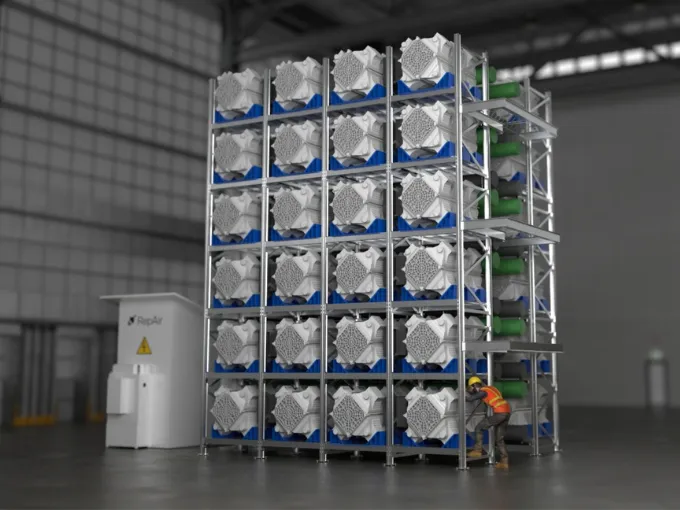
The cell technology described in the Nature Energy paper is part of RepAir’s ElectraStack system, and it captures and releases carbon dioxide at high purity as it charges and discharges, using the same nickel hydroxide chemistry found in rechargeable batteries.
The paper confirms the same low energy consumption of RepAir’s technology across three different trials: when assessed independently at the University of Delaware, over time at RepAir and when deployed at a larger scale by RepAir.
When tested by University of Delaware researchers, a 25 cm² laboratory cell captured CO2 from ambient air (400 ppm) at an average energy cost of 1.15 MWh per tonne of carbon dioxide.
83 MWh per tonne CO2 with a pressure drop below 300 Pa, meeting the requirements for efficient DAC at scale.
Source link