This article has been reviewed according to Science X's editorial process and policies. Editors have highlighted the following attributes while ensuring the content's credibility:
Hydrogen could help industries reduce their dependence on fossil fuels, but its environmental benefits depend largely on how it is produced. Conventional hydrogen production can release substantial amounts of greenhouse gases, creating a need for technologies that not only reduce emissions but also help remove carbon dioxide from the atmosphere.
Researchers at Jeonbuk National University in South Korea have studied how combining biomass-based hydrogen production with carbon capture and storage could address this challenge. Their findings suggest that generating electricity within the production facility, rather than relying on the power grid, could significantly improve the climate benefits of hydrogen production.
The paper was published in the journal Bioresource Technology on Sept. 1, 2026.
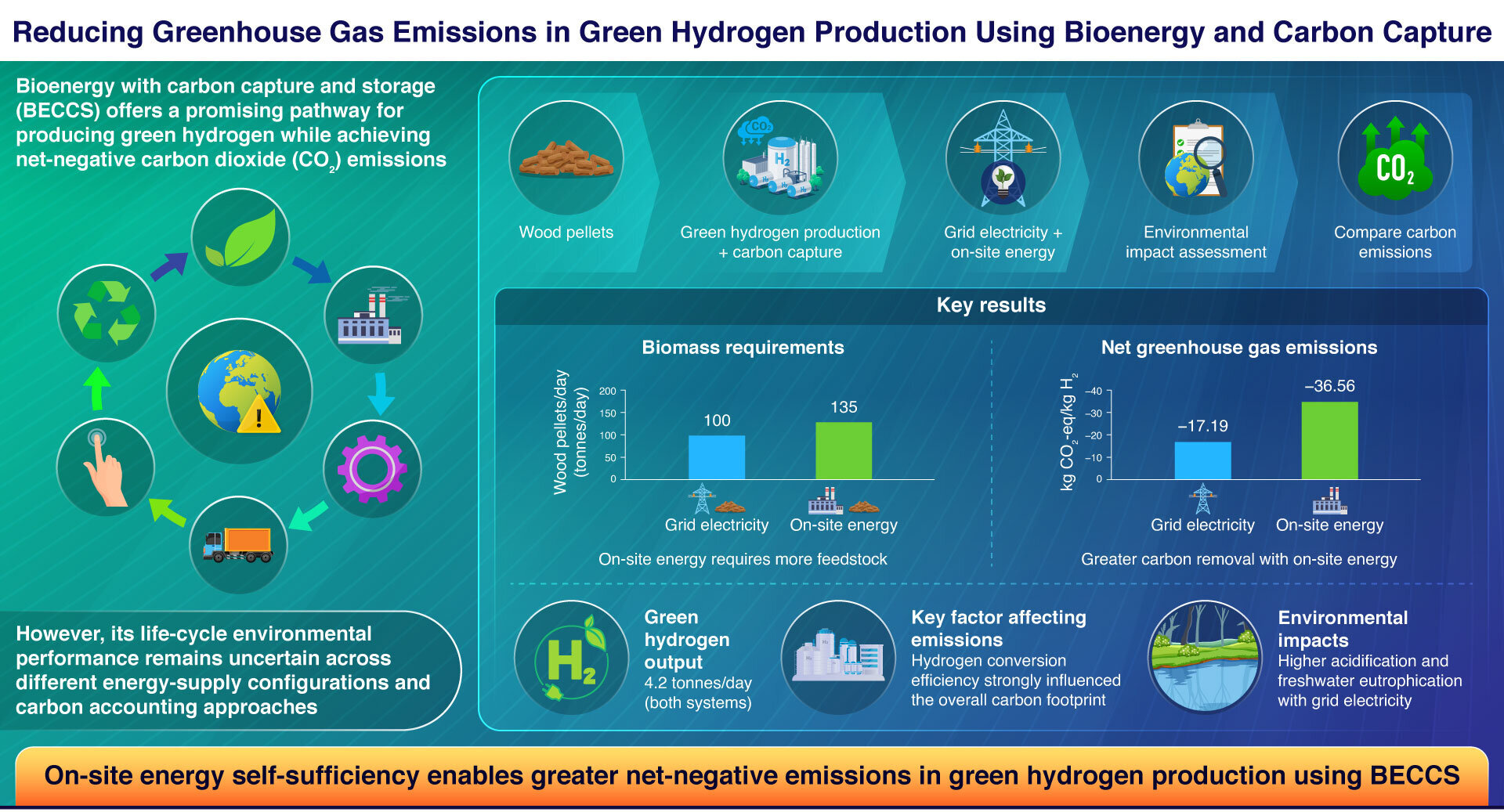
The approach, known as bioenergy with carbon capture and storage (BECCS), uses organic materials such as wood pellets to produce hydrogen while capturing the carbon dioxide released during processing and storing it underground. When biomass is sourced sustainably and the captured carbon remains securely stored, the process could remove more greenhouse gases than it releases.
To assess its environmental benefits, the researchers examined emissions across the entire production process, including biomass supply, transportation, hydrogen production and carbon storage. They compared two systems designed to produce similar amounts of hydrogen: one using electricity from the power grid and another generating its own electricity from biomass and heat recovered during production.
Both systems showed the potential to achieve net-negative greenhouse gas emissions, meaning they could remove more greenhouse gases from the atmosphere than they release.
Source link