
This article has been reviewed according to Science X's editorial process and policies. Editors have highlighted the following attributes while ensuring the content's credibility:
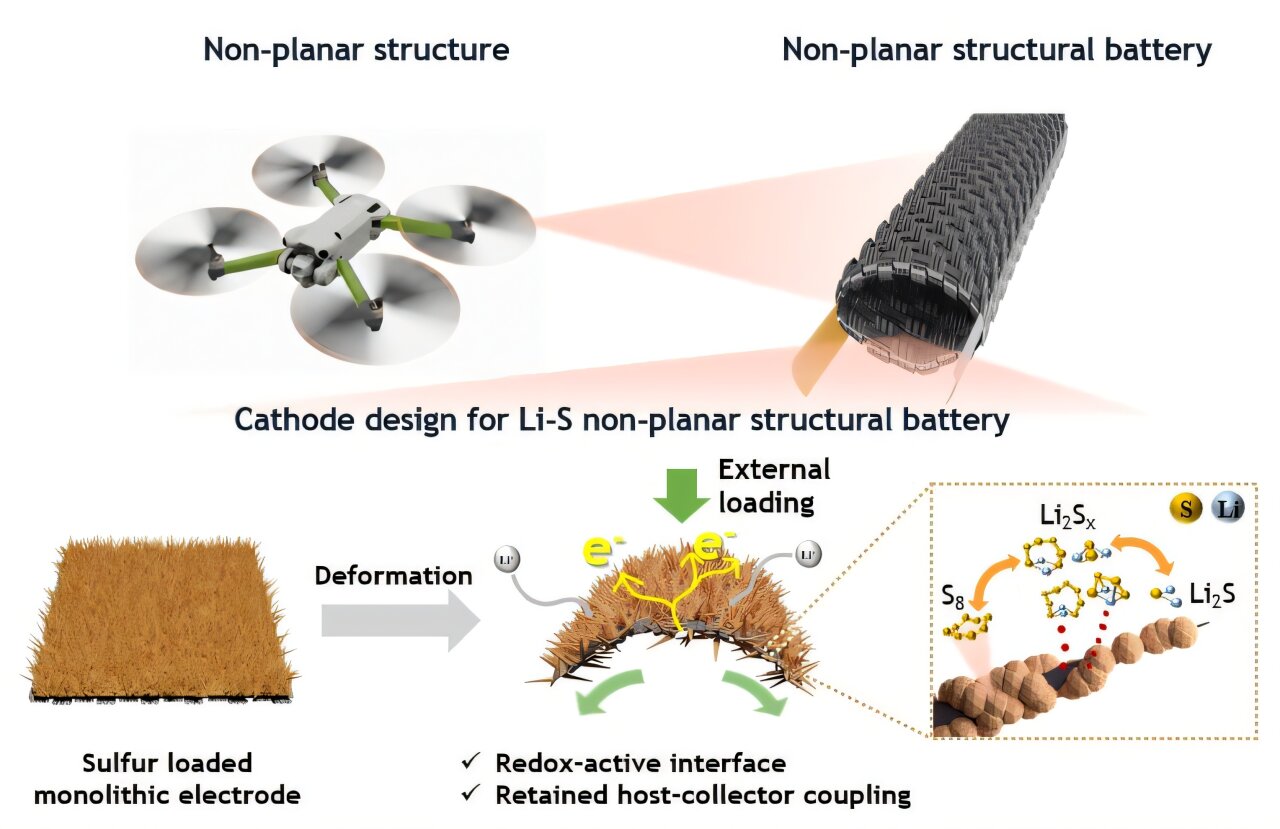
What if a drone's legs could do more than support its weight—and also store energy? Researchers at the Korea Advanced Institute of Science and Technology (KAIST) have developed a structural battery electrode that remains stable even when fitted into curved structures, such as drone legs. By making it possible to integrate energy storage into a device's frame, the technology could help make drones and robots lighter and extend their operating times.
A research team led by professor Il-Kwon Oh of the Department of Mechanical Engineering has developed a monolithically integrated lithium-sulfur (Li-S) battery cathode by growing nickel cobalt selenide (NiCo₂Se₄) nanowires directly on woven carbon cloth. Made from interwoven carbon fibers, the carbon cloth serves as a mechanically robust, flexible and electrically conductive foundation for the electrode. By growing ultrafine nanowires directly on its surface, the researchers created an electrode that combines mechanical robustness with reliable electrical conductivity.
The paper is published in the journal Advanced Composites and Hybrid Materials.
For drones and robots, maximizing energy storage while minimizing weight and space is a major engineering challenge. Conventional designs use separate batteries and structural frames, limiting opportunities to reduce overall weight and volume. Structural batteries offer a promising alternative by allowing components to both support mechanical loads and store energy. In a drone, for example, the landing legs could serve as structural supports while also functioning as part of the energy storage system.
Source link





