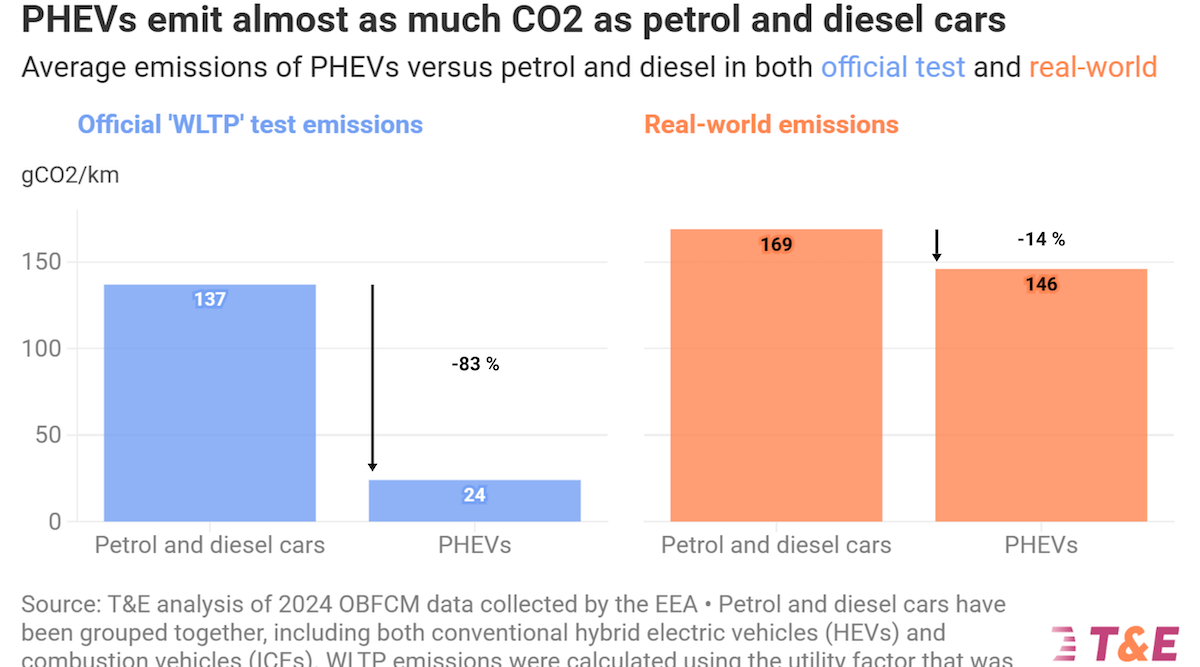

Analysis of official 2024 real-world data reveals that plug-in hybrid electric vehicles (PHEVs) continue to exhibit a widening gap between real-world performance and official WLTP (Worldwide Harmonised Light Vehicle Test Procedure) testing values. On average, real-world emissions for 2024 PHEV models were nearly six times higher than official figures. The widening gap is driven largely by the market shift toward heavier, higher-power, longer-range models that lack sufficient electric motor power. These empirical findings underscore the necessity of the upcoming November 2026/27 utility factor (UF) correction to align official accounting with actual climate impact and incentivize meaningful vehicle performance improvements.
Correcting the plug-in hybrid electric vehicle UF does not threaten the European PHEV producers, it ensures that PHEV design and performance are improved. Market evidence from the past 2025 UF correction shows that CO2 emissions can be reduced through better technology and longer electric range to offset the increase in official CO2 emissions from the UF correction.
The UF corrections encourage manufacturers to develop PHEVs with longer electric ranges. However, demand also determines which models succeed, and taxation plays a key role in influencing buyers’ choices. In most Member States, current PHEV taxation does not prevent high-emitting models from receiving more favourable treatment than best-performing PHEVs.
Real-world fuel consumption data reveal that PHEVs climate benefits were overstated and have emissions close to traditional combustion cars:
The evidence from recent PHEV model launched after the 2025 UF correction suggests that the UF correction incentivised technical improvements:
T&E’s analysis shows that, by 2030, electric ranges of around 140–220 km will keep PHEVs at or below 50 gCO 2 /km.
Source link