
T&E urges governments to uphold the next correction of the PHEV CO2 accounting rules to drive PHEV improvements and avoid cheating consumers. Powering a PHEV costs drivers up to €680 more a year than carmakers claim.
The gap between plug-in hybrids’ official CO₂ figures and their real-world emissions is widening. PHEV models registered in 2024 emitted around six times their official CO₂ figures on the road, up from a five-fold difference in 2023, according to a new T&E report. This gap adds €680 in extra annual fuel expenses for the average driver of a PHEV sold in 2024.
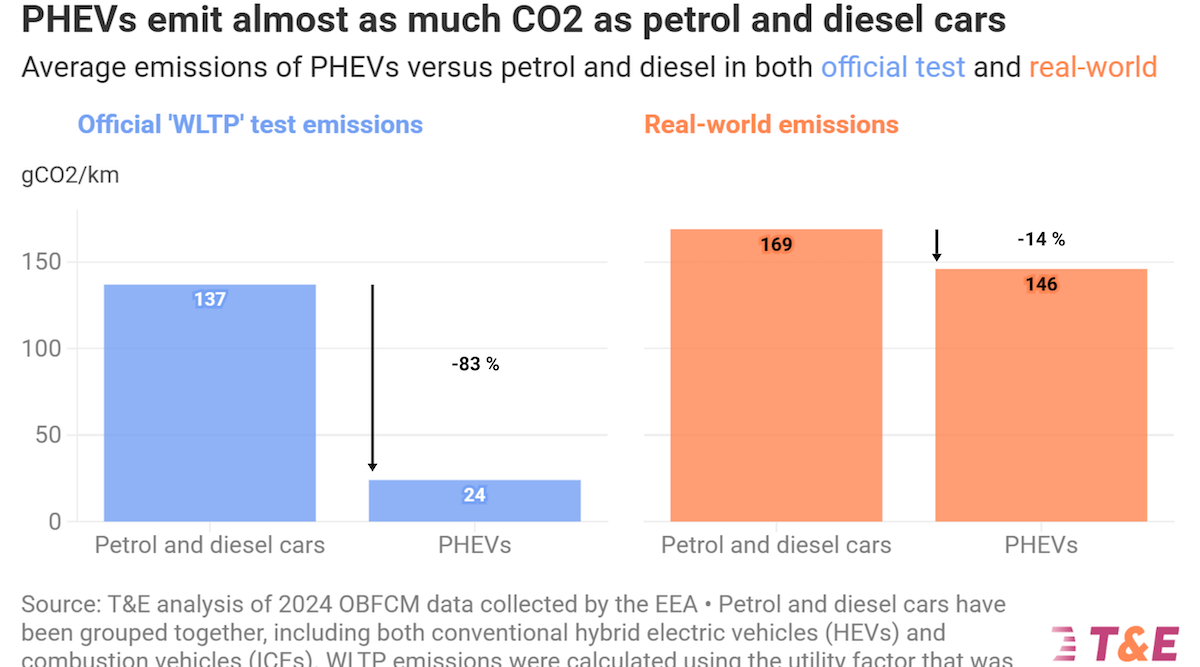
The analysis of European Environment Agency data finds PHEV real-world emissions just 14% lower than those of conventional combustion and hybrid cars, despite official test figures suggesting an 83% reduction. Even when the battery is powering the vehicle, the combustion engine operates for roughly a third of kilometres driven.
The EU is addressing the real-world emissions discrepancy by correcting the “utility factor,” which sets the share of driving powered by electricity when calculating official PHEV emissions. T&E finds that the first correction in 2025/6 has already encouraged manufacturers to fit larger batteries and extend electric range. According to the report, longer electric range offset three-quarters of the utility factor-related rise in official CO₂ emissions for upgraded models.
The analysis also finds that further technology and design progress could keep emissions below 50 grams of CO₂ per kilometer (gCO₂/km)¹ once the EU PHEV emission rules have been further corrected. With the next correction of the PHEV accounting rules due to start in November 2026, T&E urges governments to keep it in place to account for the real emissions of PHEVs.
Source link