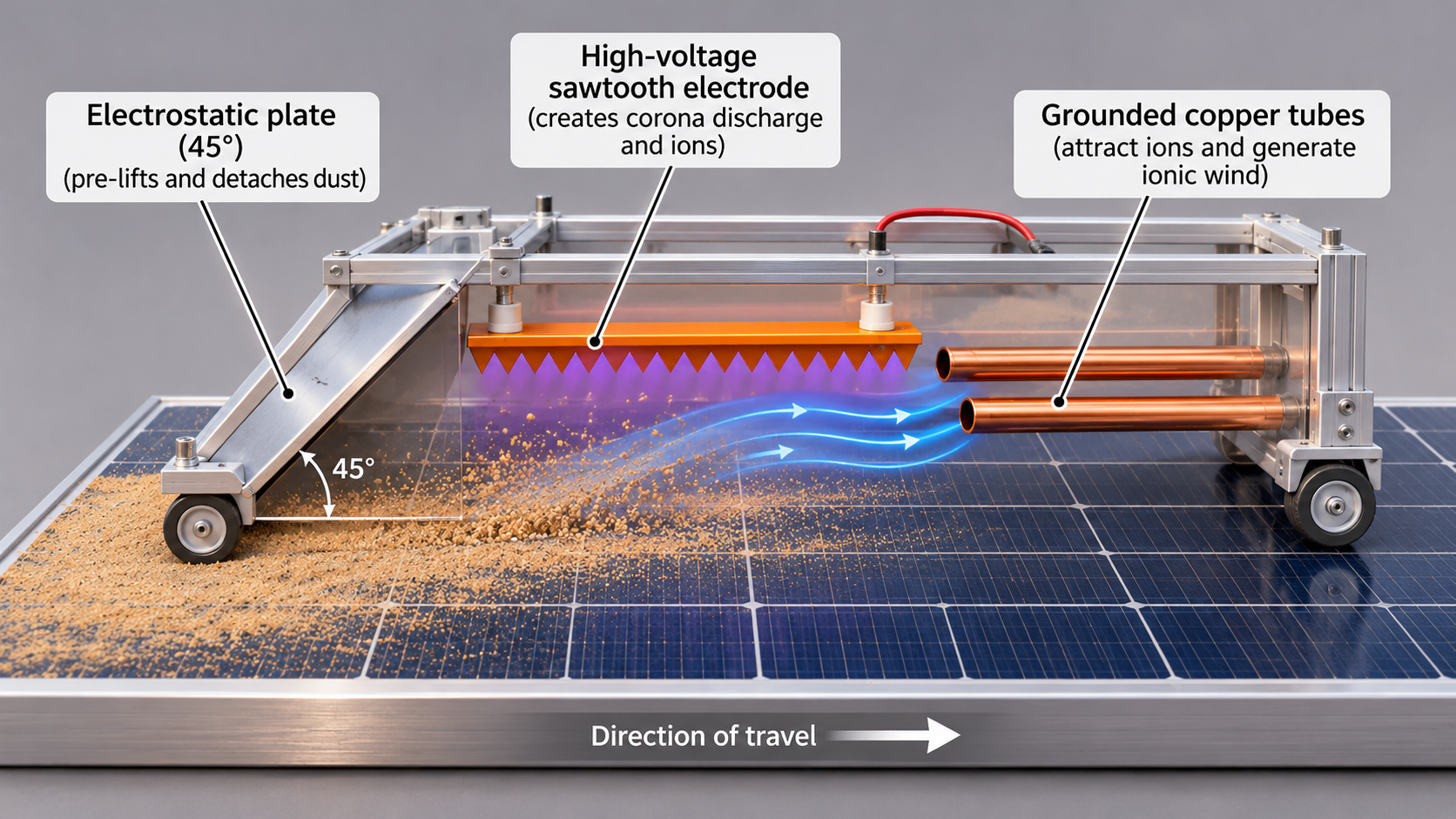
A research team in Algeria has developed a hybrid dust-removal system for PV panels that combines an electrostatic plate with a corona-induced ionic wind. The researchers built a prototype and filed a patent application.
“The primary novel contribution lies in this two-stage approach: The electrostatic field of the leading plate is intended to oppose particle adhesion and pre-lift the dust, which is then transported away by the electrohydrodynamic drag force of the ionic wind,” the researchers said. “By combining particle detachment and transport, this dual-action strategy overcomes the limitations of standalone electrohydrodynamic methods.”
The researchers built a 60 cm-wide cleaning head mounted on a wheeled platform that moves along a horizontal PV panel, covering its full width in a single pass. At the front, a metal plate inclined at 45 degrees generates an electric field that helps lift sand grains from the glass surface. Behind the plate, a high-voltage sawtooth electrode produces a strong electric field at its tips, ionizing the surrounding air and generating a localized electrical discharge known as a corona. As the ions move toward two grounded copper tubes, they propel surrounding air molecules, creating an ionic wind that sweeps away the loosened sand grains.
1 m² section of PV glass, with initial dust loadings ranging from 30 g/m² to 130 g/m². They weighed the sand before and after a single cleaning pass to calculate the percentage removed by mass. They also varied the applied voltage, travel speed, plate-to-glass distance, dust loading, and grain size, while measuring the discharge current and outlet airspeed.
Source link