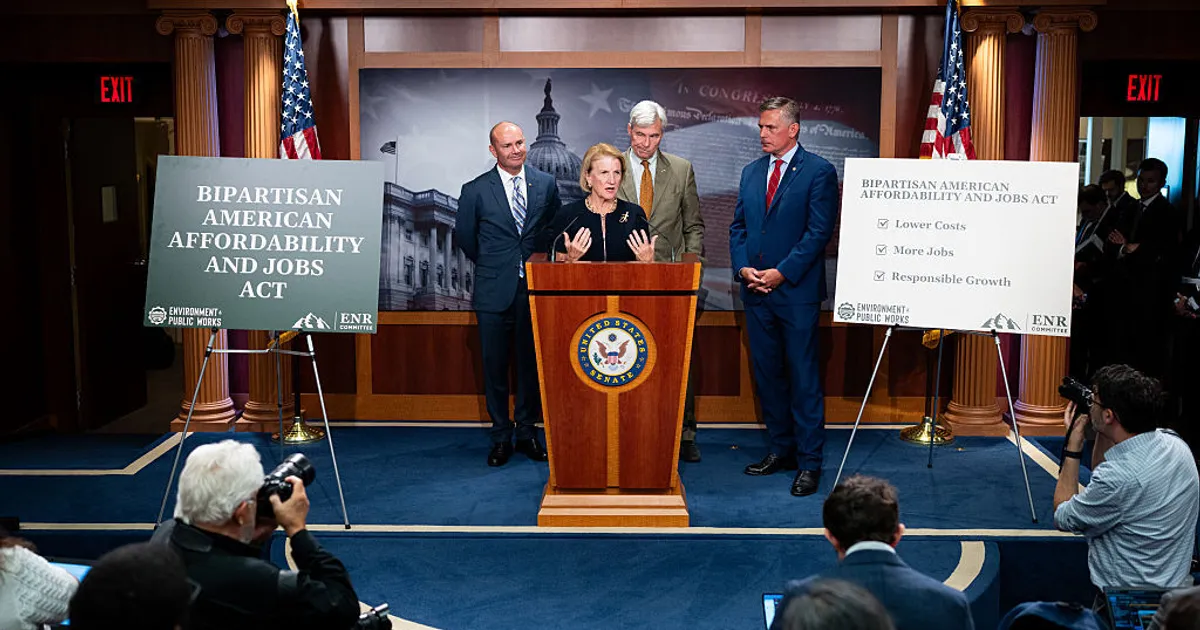
A bipartisan bill that would make it easier to build energy infrastructure — both dirty and clean — has passed the Senate by a 62 to 33 vote.
The sprawling Bipartisan American Affordability and Jobs Act would streamline permitting for energy and infrastructure projects by enacting significant changes to federal environmental regulations and introducing new policy mechanisms around data centers and the transmission grid. It would also provide developers with greater protections once a project is greenlit.
The House of Representatives will now take up the legislation, which was co-written by Democratic Sens. Martin Heinrich (N.M.) and Sheldon Whitehouse (R.I.) — two vocal supporters of clean energy — and Republican Sens. Mike Lee (Utah) and Shelley Moore Capito (W.Va.). The bill’s supporters aim to pass the current version now, while it has bipartisan momentum, rather than risk holding out for a better deal under the Democratic-led Congress next year.
Analysts widely expect that the legislation would accelerate the deployment of renewable energy — already the nation’s fastest-growing source of electricity. Critically, the bill would also help speed up the construction of transmission lines, which are needed to bring new energy generation online but notoriously difficult and slow to build in America. It would also ease permitting for fossil-fueled power plants, pipelines, and data centers.
The bipartisan bill has attracted a wide coalition of supporters that includes utility and fossil fuel groups as well as the clean-energy industry and many decarbonization advocates. But several major environmental groups, including the Sierra Club and the Natural Resources Defense Council, have come out against the legislation.
Source link