This article has been reviewed according to Science X's editorial process and policies. Editors have highlighted the following attributes while ensuring the content's credibility:
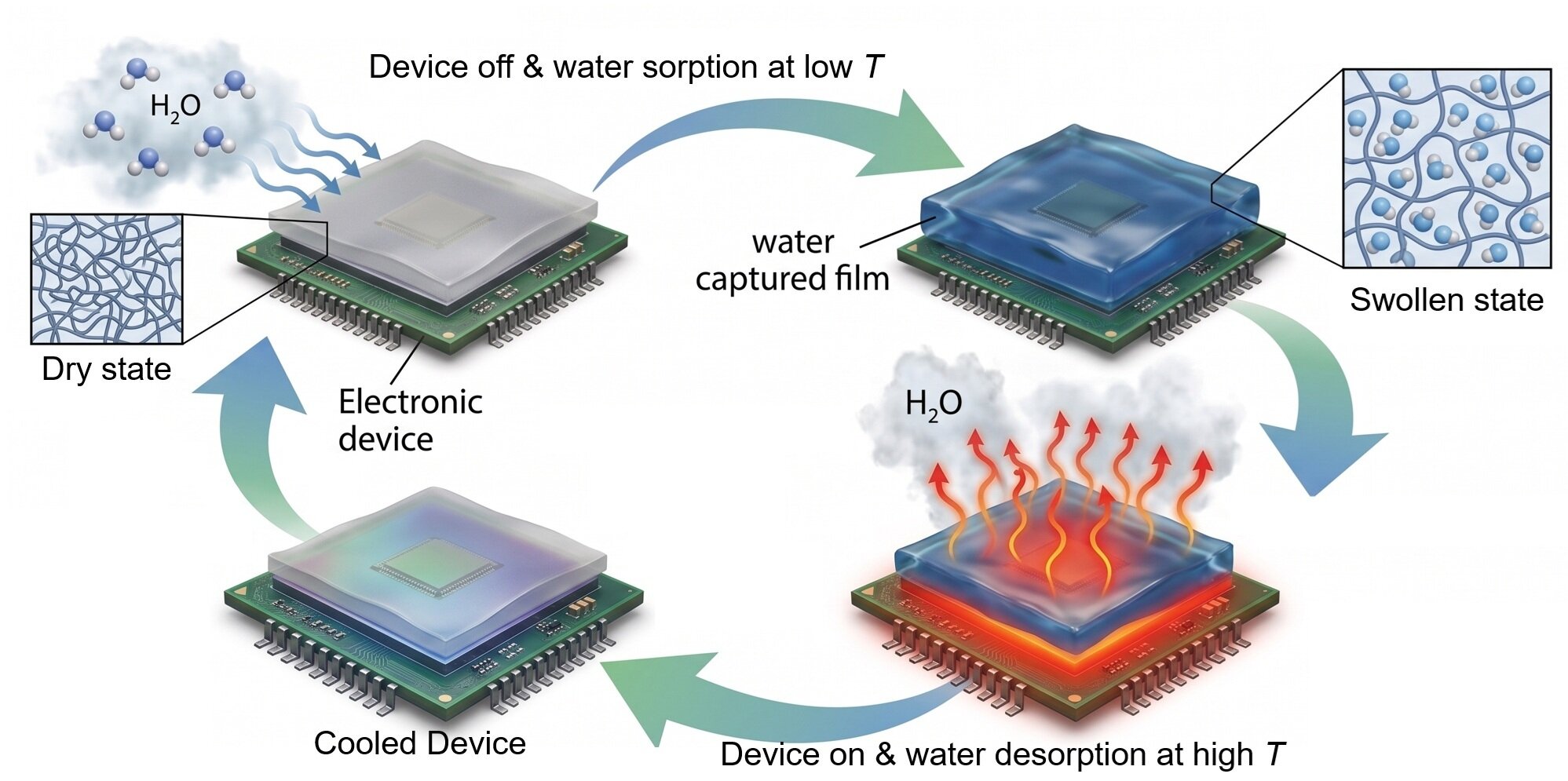
A research team led by professor Seong Kyun Kim of the Department of Physics and Chemistry at DGIST has developed a "passive cooling film material" that uses moisture in the air to cool electronic devices—no water or electricity is required.
The technology offers a potential environmentally friendly solution to thermal management challenges in AI data centers, mobile devices and electric vehicle (EV) batteries, whose cooling consumes substantial water and electricity.
Recent advances in AI technology have driven the surge in data centers, and securing the electricity and water resources required for their thermal management has emerged as a global challenge. Likewise, mobile devices and EV batteries require technologies that can efficiently dissipate heat within confined spaces.
However, conventional active cooling methods that operate pumps or fans require electrical energy and a coolant (water), and their complex systems entail significant maintenance costs.
Accordingly, passive cooling technologies that require no external energy input—particularly evaporative cooling technologies that use airborne moisture—have emerged as an alternative. However, most conventional hygroscopic materials—that is, materials that absorb moisture—are rigid crystalline solids that do not adhere firmly to the surfaces of electronic devices and induce corrosion. These are significant limitations to their commercialization.
Kim's research team addressed these limitations by combining "nanocellulose," which has excellent moisture-storing capacity, with organic ionic molecules with robust hygroscopic properties to synthesize a flexible, adhesive film material.
Source link