This article has been reviewed according to Science X's editorial process and policies. Editors have highlighted the following attributes while ensuring the content's credibility:
Scientists from the Institute of Metal Research (IMR) of the Chinese Academy of Sciences have established a new paradigm for designing oxide cathode materials. They have moved beyond empirical trial and error toward goal-oriented design using physicochemical descriptors.
The performance of lithium-ion batteries depends on the energy density, rate capability, cycle life and safety of their oxide cathodes. Introducing trace elements has become an important way to adjust the crystal structure, ion transport and cycling stability. However, the selection of dopants has long relied on experience and repeated testing. This approach lacks quantitative descriptors that link a dopant's intrinsic properties to lattice structure and electrochemical performance.
This issue is especially significant for cobalt-free, nickel-rich cathodes, as cobalt removal decreases cost and increases capacity, yet it also intensifies sluggish lithium-ion transport, local lattice distortion, oxygen framework instability and electrochemical failure.
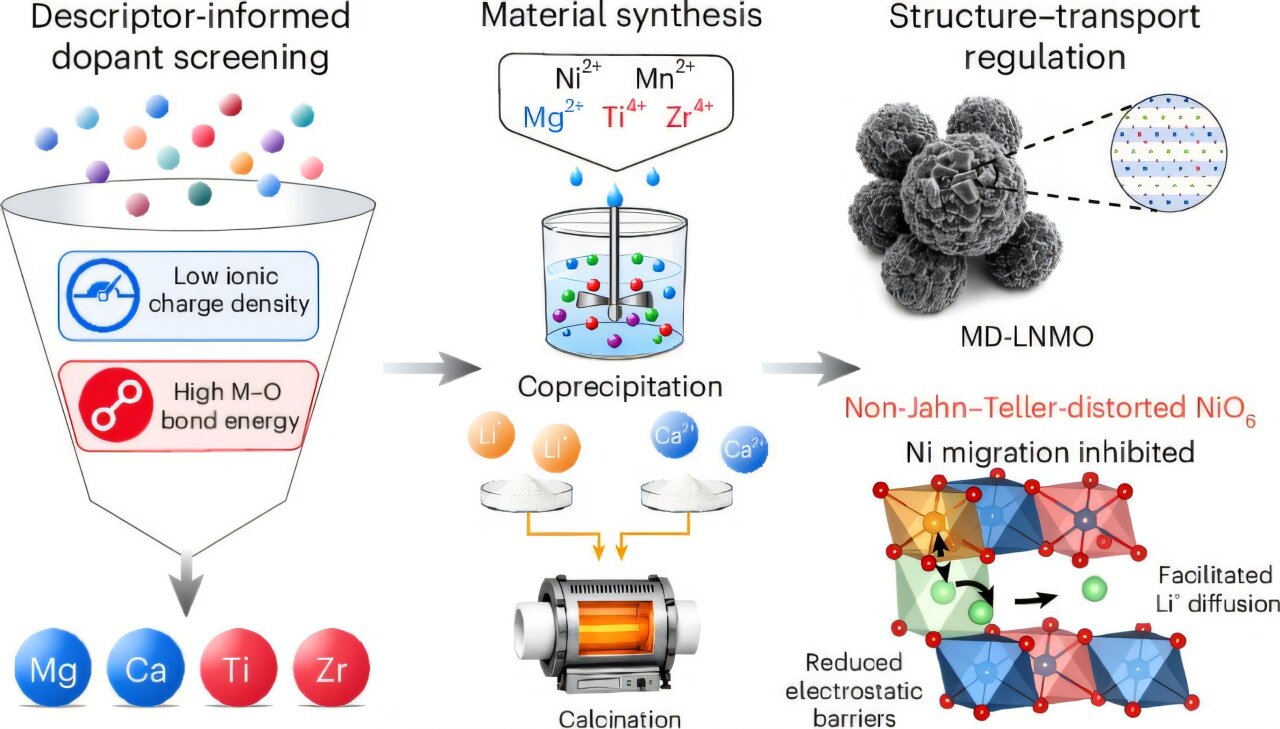
The researchers, led by professors Li Feng, Cheng Huiming and Wang Chunyang, proposed a descriptor-informed multicomponent doping strategy. They identified two key parameters—ionic charge density and metal-oxygen bond strength—as descriptors that establish intrinsic correlations between dopant properties, lithium-ion transport and structural stability.
Guided by this framework, the researchers introduced elements with low ionic charge density (Mg and Ca) to weaken electrostatic constraints on lithium-ion migration and elements with strong metal–oxygen bonds (Ti and Zr) to reinforce the oxygen sublattice and transition-metal–oxygen framework.
The resulting cobalt-free, nickel-rich cathode (MD-LNMO) demonstrated simultaneous improvements in rate performance and structural stability.
Source link