This article has been reviewed according to Science X's editorial process and policies. Editors have highlighted the following attributes while ensuring the content's credibility:
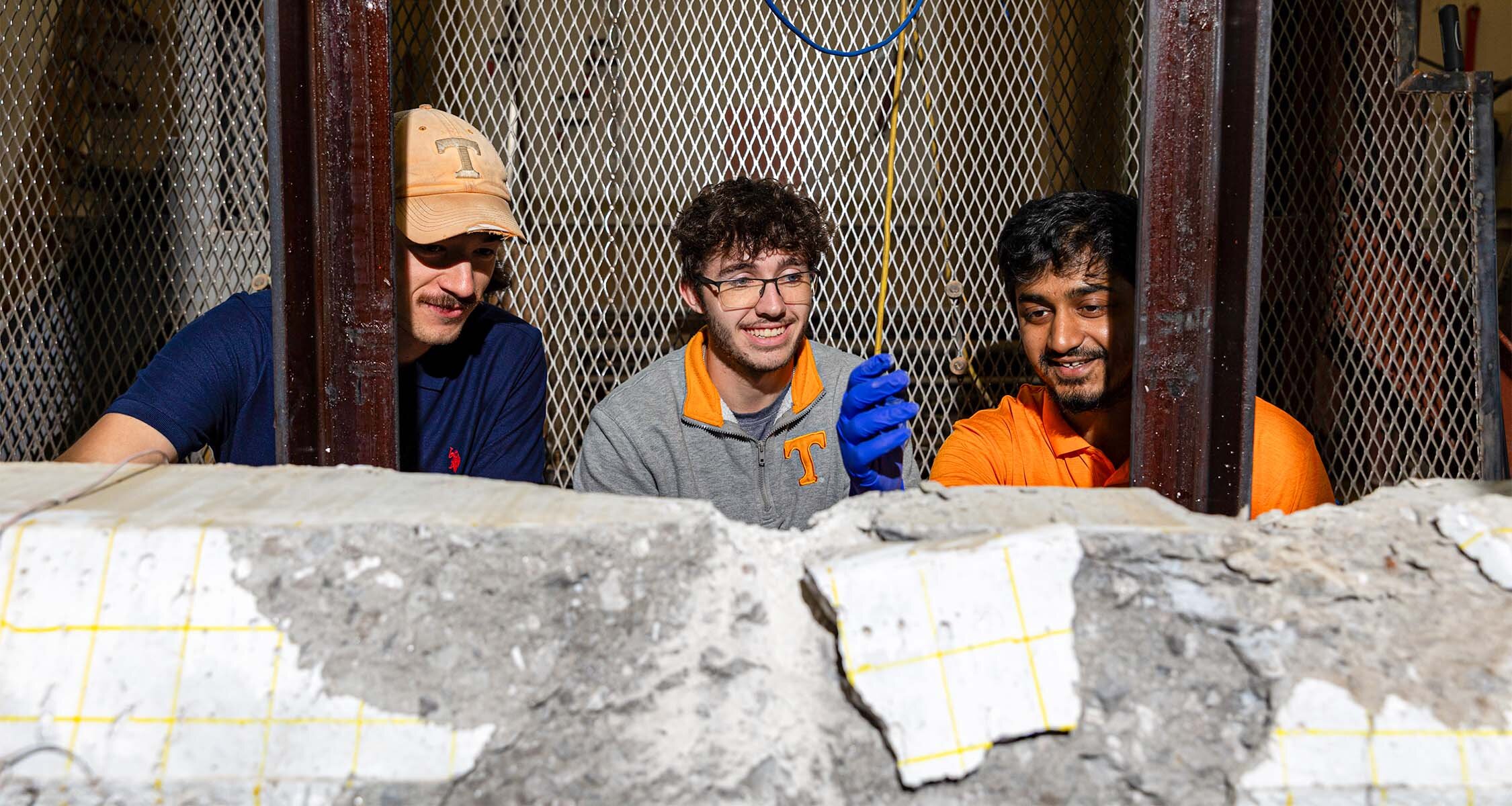
If you are inside the John D. Tickle Engineering Building at the University of Tennessee, Knoxville, and think you hear a semitruck slamming into a highway overpass, your ears aren't deceiving you. You've just stopped by during an experiment that promises to improve Tennessee's bridges.
"The majority of our bridges in Tennessee—and nationally—were designed according to old specifications, with a (lower) clear height," said Department of Civil and Environmental Engineering (CEE) professor John Ma. "So if you have a (tall, modern) vehicle driving underneath, then they're going to hit the bottom of the support beams, (which) can cause tremendous damage."
High-energy vehicle strikes strip away concrete protection, exposing the structural steel within overpass support beams. That changes stress distribution across the bridge and makes the steel susceptible to corrosion. Besides, Ma said, even if road engineers have confirmed that an overpass is safe to use after a collision, Tennesseans feel anxious driving under a bridge with a large chunk missing.
"Tennessee itself has 20,000 bridges," said Sazzadul S. Saykat, a Ph.D. student in Ma's lab. "We reviewed a bridge near Memphis that has been hit (and repaired) 13 times. That means that 13 times, they had to close the bridge and rebuild—which causes not only expense, (but) also a lot of effort and a lot of time of the (TDOT) personnel."
That's why the Tennessee Department of Transportation (TDOT) and the Federal Highway Administration tasked Ma and Saykat with finding a cost-effective, labor-efficient way to make the state's bridges more robust.
Source link