This article has been reviewed according to Science X's editorial process and policies. Editors have highlighted the following attributes while ensuring the content's credibility:
Reducing carbon dioxide emissions from steelmaking requires more efficient ways to turn iron ore into iron. While hydrogen-based technologies offer a promising path toward lower-carbon steel production, conventional blast furnaces will remain important during the transition. Understanding how iron ore behaves inside these furnaces could help improve their efficiency and stability.
A research team led by associate professor Shungo Natsui at Tohoku University, in collaboration with Tata Steel Europe, Delft University of Technology and the National Institute of Advanced Industrial Science and Technology (AIST), has developed a new method to predict the mechanical properties of iron ore pellets under extreme heat. By combining high-energy X-ray computed tomography (CT) with chemical analysis and computer simulations, the team can estimate how strongly iron-rich structures resist deformation as temperatures rise. Their research is published in Scientific Reports.
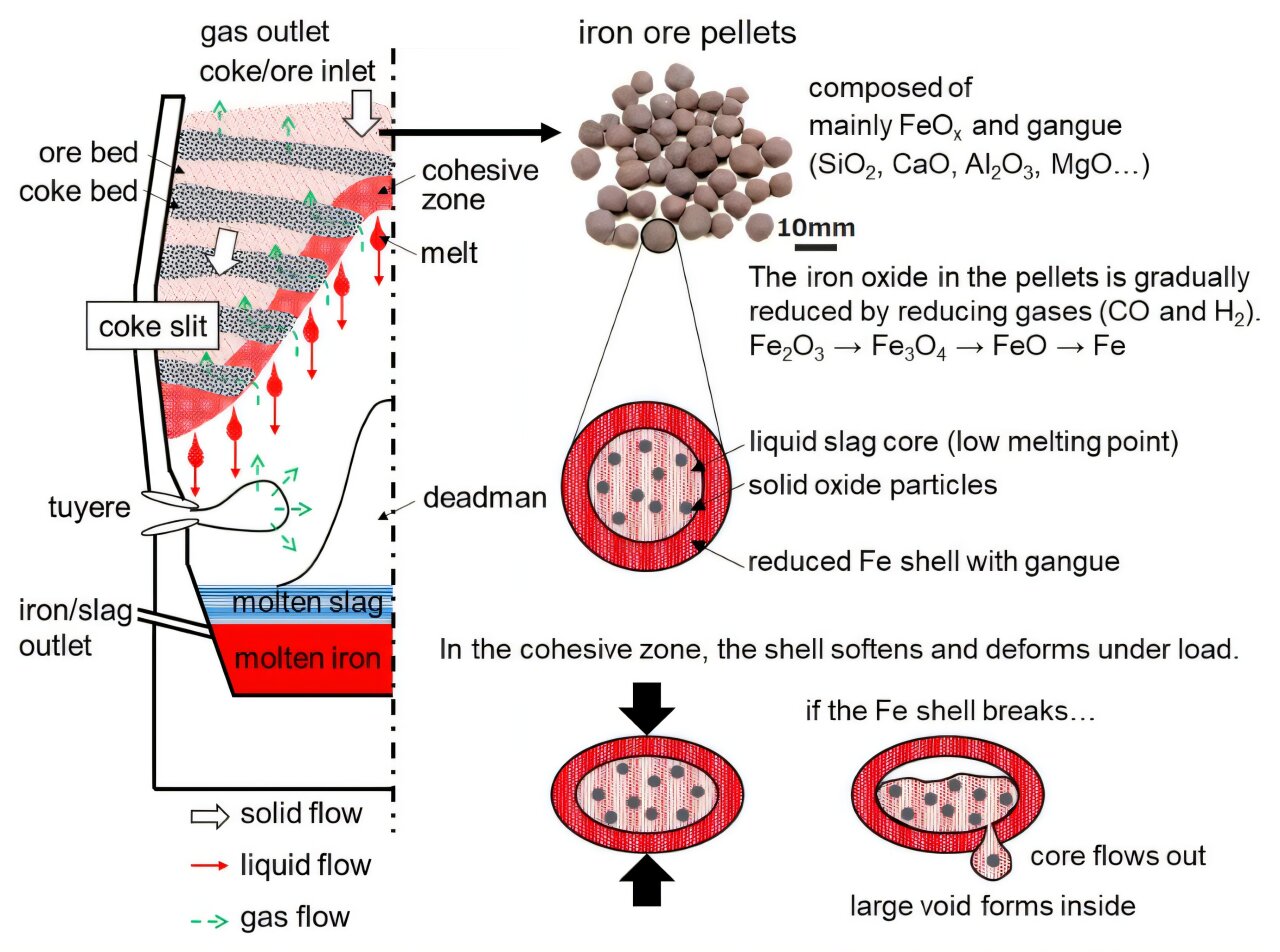
Inside a blast furnace, iron ore pellets undergo a series of changes as they are heated and chemically reduced. They gradually soften and eventually melt. Under the weight of the surrounding materials, the pellets deform, narrowing the spaces between them through which gases flow. This can restrict gas movement and affect furnace performance. However, conventional experiments have largely relied on measurements of overall bed shrinkage and gas pressure loss, making it difficult to determine how changes within individual pellets contribute to the behavior of the entire packed bed.
To investigate these processes, the researchers conducted high-temperature experiments that reproduced conditions inside a blast furnace.
Source link