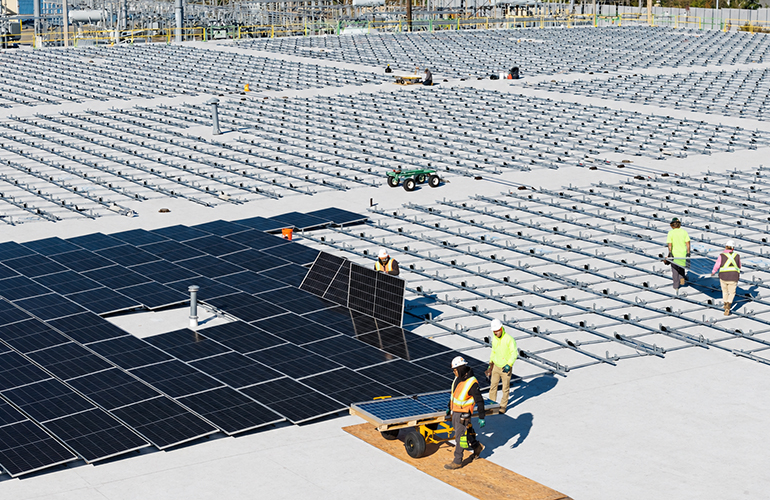
An international research team has developed a method to determine the tilt and azimuth of rooftop PV arrays using operational power data. Accurate orientation data is essential for estimating electricity generation and detecting faults, but installation records are often missing or incorrect, while site inspections are impractical for large PV portfolios.
“This study provides a method to recover panel tilt and azimuth from operational power data while accounting for partial shading and the geometric limit at low tilt,” corresponding author Hanrong Huang told pv magazine. “We tested it on 17 commercial rooftop systems in Australia with independently verified orientations. It offers a practical way to fill in missing or wrong tilt and azimuth records without a site visit.”
The researchers developed and tested the method using operational data collected in 2025 from commercial rooftop PV systems in Australia. The dataset included DC power measurements recorded at five-minute intervals for each maximum power point tracker (MPPT). They used pvlib clear-sky modeling and ERA5 weather data to estimate solar irradiance on panels at different tilt and azimuth angles.
After selecting periods with high direct irradiance and sufficient morning and afternoon measurements, the researchers used an optimization algorithm to identify the orientation that best matched the measured power output. The algorithm also adjusted effective system capacity to account for power losses.
The team also compared two fitting metrics, R² and Huber loss, and assessed the effects of shading, low tilt angles, data resolution, module temperature, and inverter clipping on accuracy. R² measures how well modeled power output matches observed data, while Huber loss reduces the influence of outliers, such as power deviations caused by shading, when fitting the model.
Source link