A research team from China’s Hebei Normal University of Science and Technology has developed an electromagnetic-thermal strategy to improve heating uniformity in PV module laminators. Uneven heating can leave encapsulants insufficiently cured in cooler areas while damaging encapsulants or cells in hotter areas. The new approach combines stepped aluminum magnetic shielding, zone-specific currents, and temperature-based current control to distribute heat more evenly across the heating plate.
“Addressing the dual challenges existing in the spatial magnetic field distribution and transient thermal response of a large-scale built-in perforated induction heating system, this paper proposes a complete electromagnetic-thermal collaborative optimization solution based on multiphysics equivalent modeling,” the team explained. “An equivalent finite element model was established to reduce the computational cost of large-scale Multiphysics coupling, with accuracy validated via a physical prototype.”
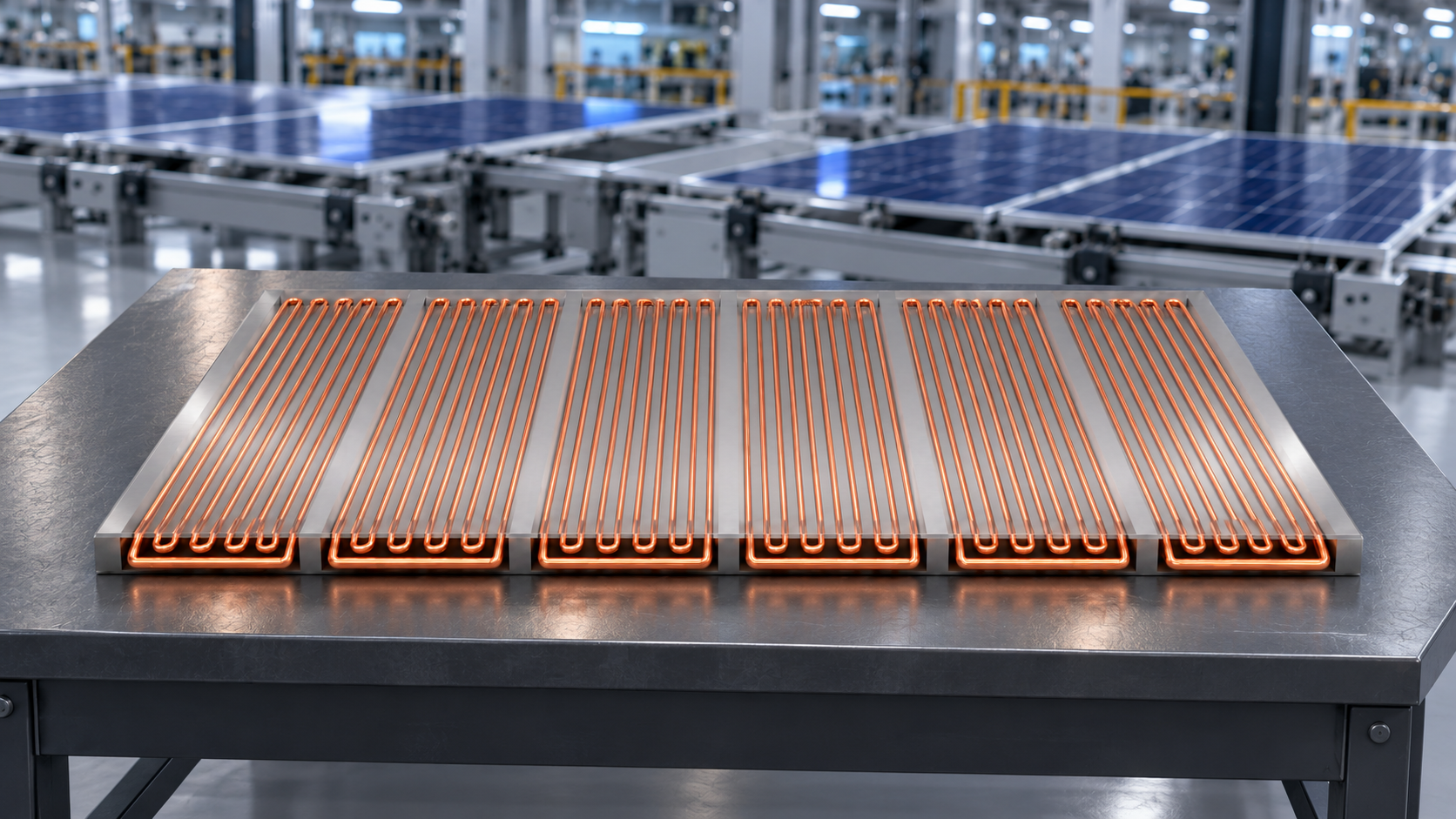
The researchers used COMSOL to simulate electromagnetic heating and heat transfer in a 4,750 mm × 2,900 mm × 45 mm steel plate comprising six zones with embedded copper coils. A simplified two-zone model accounted for temperature-dependent material properties, heat conduction, and convective and radiative losses.
They selected an excitation current of 38 A and a frequency of 15 kHz, then optimized stepped aluminum shielding to suppress localized overheating. Finally, they adjusted the two zones’ currents to 37 A and 38 A and introduced a control function that reduced current as temperatures approached 150 C.
“Under the baseline electrical parameters, the maximum temperature difference on the working surface was approximately 29 C,” the results showed.
Source link