This article has been reviewed according to Science X's editorial process and policies. Editors have highlighted the following attributes while ensuring the content's credibility:
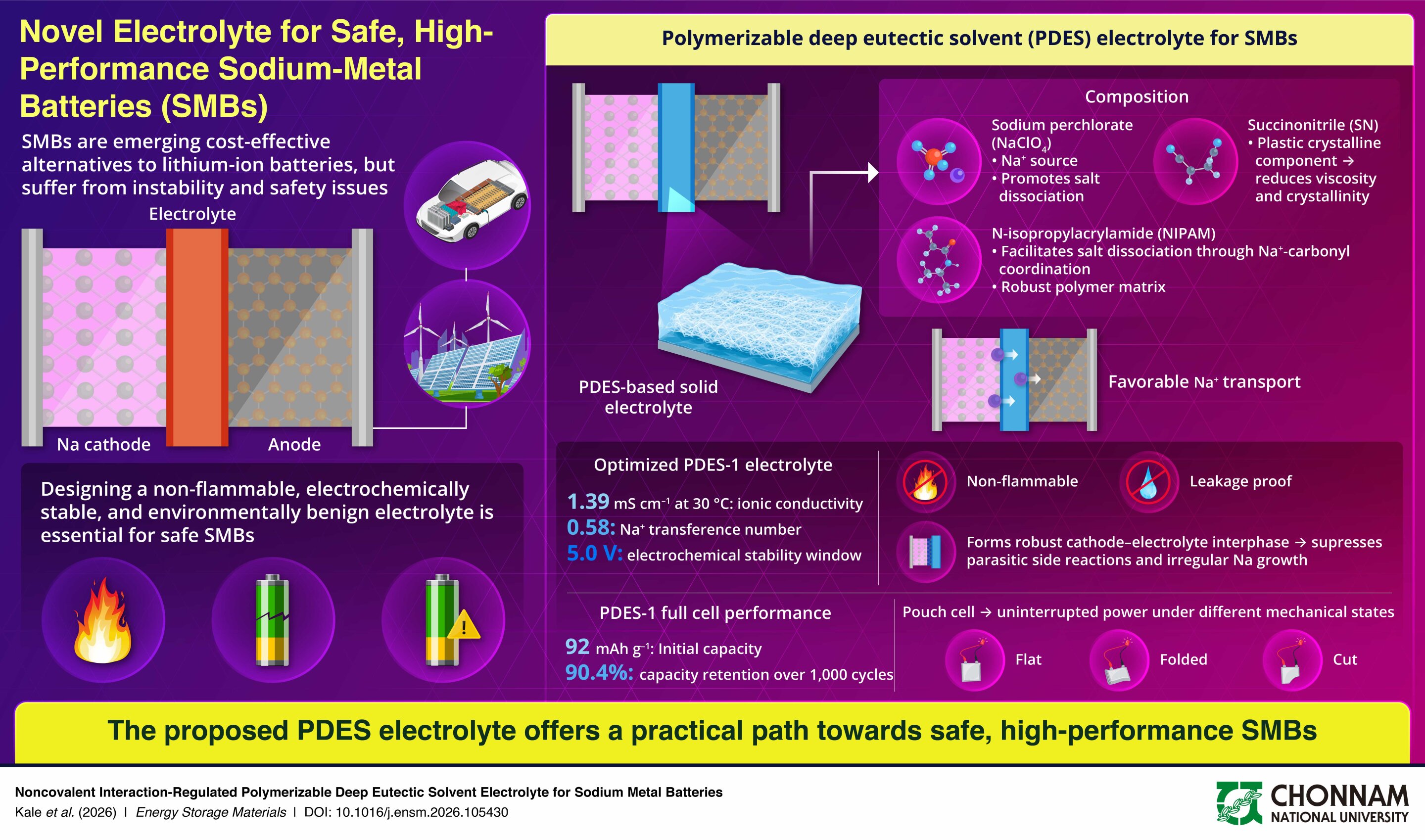
In recent years, sodium-metal batteries (SMBs) have gained increasing attention for next-generation energy storage technologies due to the abundance and low cost of sodium (Na) reserves, making them cost-effective alternatives to current commercial lithium-ion batteries. However, the practical applications of SMBs are still limited by critical safety and stability issues.
SMBs face challenges such as the high reactivity of sodium metal, dendrite growth and unwanted side reactions, all of which can shorten battery life. When deployed at scale in energy storage systems, high operating temperatures can cause catastrophic failure. In addition, conventional organic liquid electrolytes are volatile, highly flammable and toxic, adding to safety and environmental concerns.
Now, a research team led by Professor Chan-Jin Park from the Department of Materials Science and Engineering at Chonnam National University in South Korea has developed a new polymerizable deep eutectic solvent (PDES) electrolyte that can address these challenges.
"Our electrolyte combines efficient Na-ion transport with improved safety, leakage resistance and interfacial stability, making it a promising candidate for practical sodium-metal batteries," explains Park. Their study was published in Energy Storage Materials.
The proposed PDES electrolyte is composed of sodium perchlorate (NaClO₄), N-isopropylacrylamide (NIPAM) and succinonitrile (SN). When mixed, these components form a homogeneous liquid stabilized by intermolecular interactions, including noncovalent interactions like hydrogen bonding and ion-dipole interactions.
This mixture, called a deep eutectic solvent (DES), has attractive properties like nonflammability and chemical and thermal stability.
Source link