
This article has been reviewed according to Science X's editorial process and policies. Editors have highlighted the following attributes while ensuring the content's credibility:
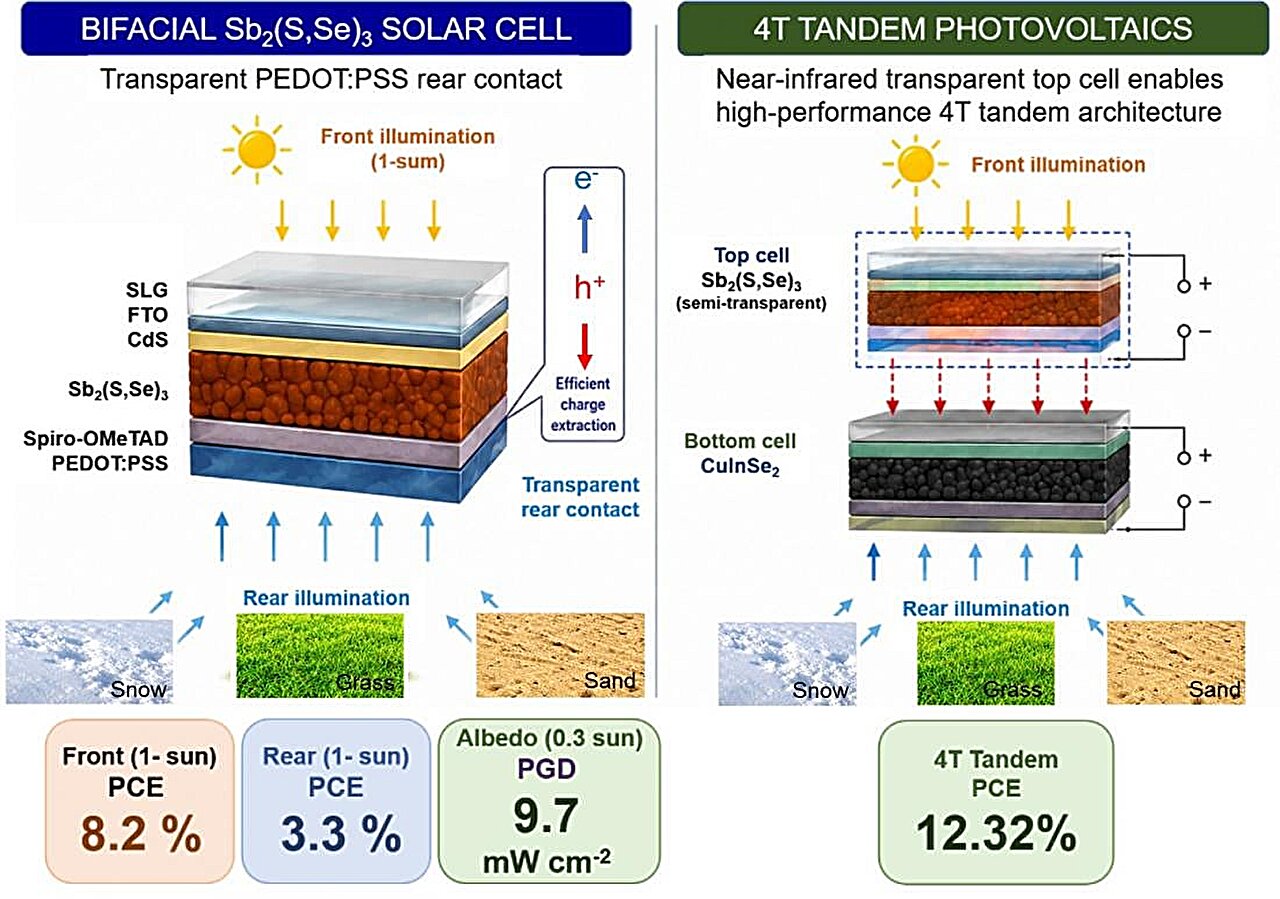
To increase the amount of electricity generated by solar cells, it is essential to develop technologies that capture and harness not only direct sunlight but also light reflected and scattered by the ground and surrounding objects. In this regard, two approaches have attracted considerable attention as next-generation solar cell technologies: bifacial structures, which absorb light from both the front and rear sides, and tandem structures, which enhance efficiency by stacking two solar cells that absorb different wavelengths of light.
However, a major challenge in realizing efficient bifacial power generation has been the development of a high-performance, highly transparent rear electrode that allows light to pass through while efficiently collecting electrical current.
A research team led by Dae-Kue Hwang and Dae-Hwan Kim of DGIST's Division of Energy & Environmental Technology addressed this challenge by developing a high-performance transparent rear electrode structure comprising multiple layers of specialized transparent conductive polymers deposited through a solution-based process. In particular, the team added a specific additive (DMSO) to the conductive polymer to precisely control its electrical conductivity. This approach reduced electrical resistance, which impedes the flow of current, by a factor of 10,000 (four orders of magnitude) while maintaining high optical transparency.
The technology is expected to maximize solar cell efficiency by harnessing previously unused reflected light to generate electricity. The findings are published in Advanced Materials.
Source link





