
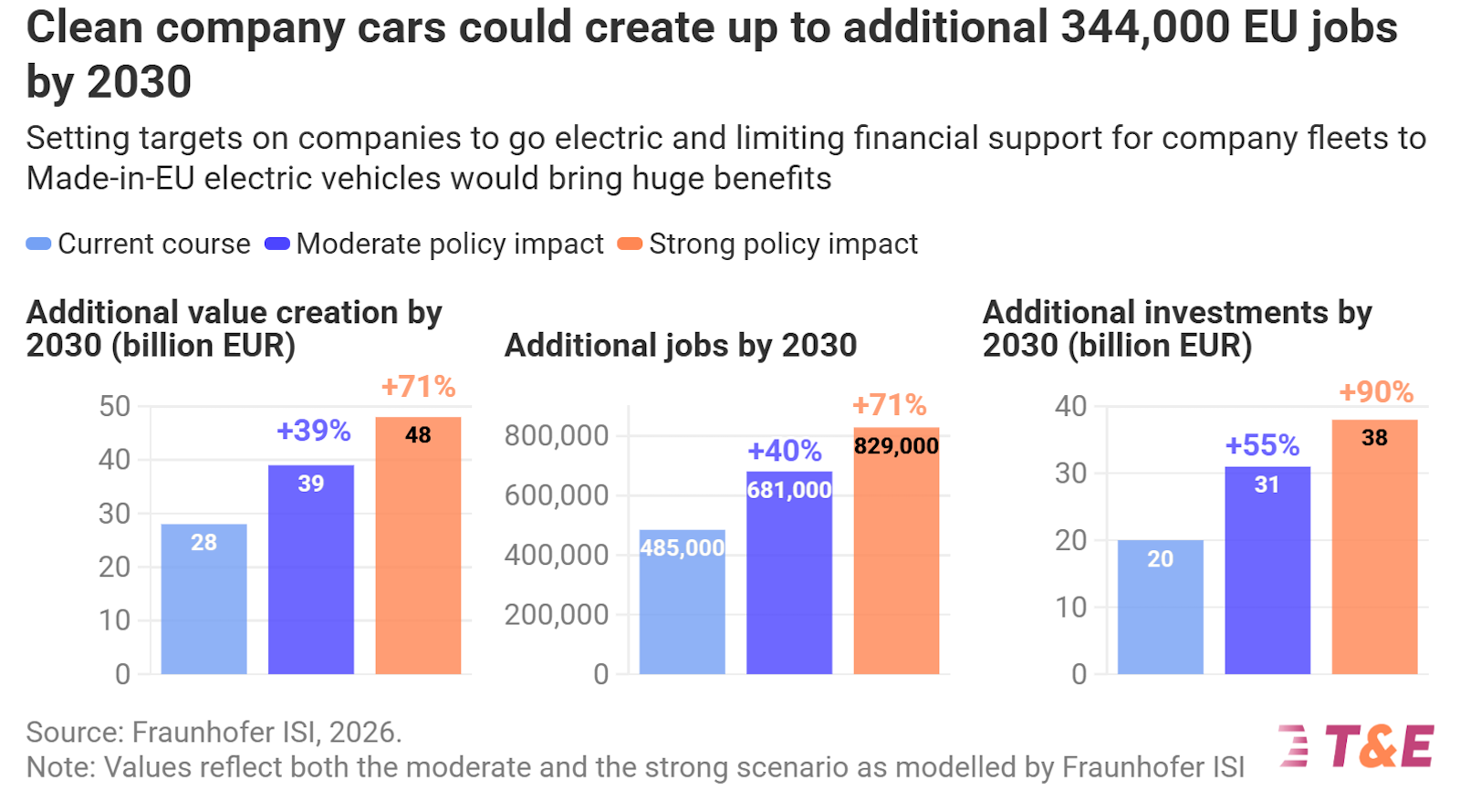
Setting targets on companies to go electric and limiting financial support only for company cars that are electric and Made-in-EU would see economic gains of €20 bn and boost investments by €18 bn
EU-wide electrification targets for large fleets, combined with limiting national fiscal benefits only to electric Made-in-Europe company cars, would bring 344,000 additional jobs and €18 billion in extra investment to Europe’s economy and automotive industry by 2030, according to a new T&E study. Even under a moderate scenario, 196,000 jobs would be created.
The Clean Corporate Vehicles Regulation requires 45% of new car sales in large corporate fleets to be electric by 2030. This establishes a minimum floor for fleet transition. Strictly limiting financial support for company cars from January 2028 (Article 4 of the Regulation) to vehicles that are low and zero emissions and Made-in-Europe triggers the biggest gains.
T&E analysis shows that in the strong scenario, where combustion cars are pushed out of company fleets much faster, 69% of new cars in large corporate fleets could be electric by 2030, generating 344,000 additional jobs. Economic gains could also jump from €28 bn to €48 bn, while investments could grow from €20 bn to €38 bn. Germany and Poland stand to reap the greatest benefits. Demand for additional jobs in Germany could rise by 134,000 (39% of the additional EU jobs), while Poland could capture 38,500 jobs more.
Sofie Grande y Rodriguez , Clean Fleets Policy Manager at T&E, said: “Company cars are the quickest way to turn Europe’s EV transition into European jobs.
Source link