
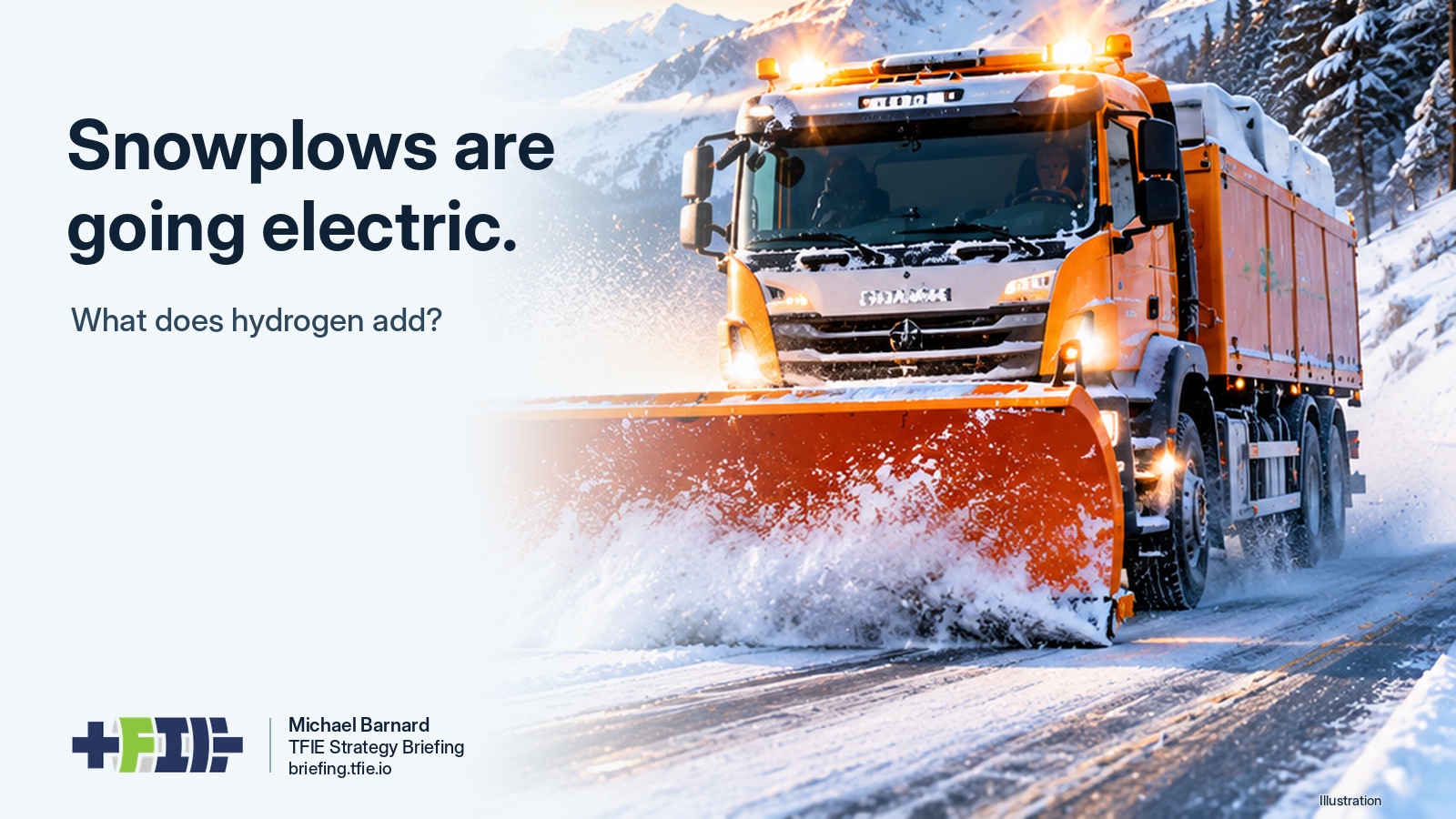
Norway has already demonstrated battery-electric snowplowing on one of its toughest mountain highways. A Scania 45 R covered roughly 7,000 km on Hardangervidda, plowing, grading and spreading sand through a Norwegian winter. Its performance exceeded expectations. Meanwhile, Sweden has unveiled a hydrogen snowplow that is, in fact, another large battery-electric truck, with a fuel cell and hydrogen tanks added for extra range. The engineering question is why that second energy system is worth having when batteries are already doing the work, and when a conventional generator running on renewable diesel could offer a simpler, potentially cheaper route to occasional extended operation.
The Swedish vehicle has to compete with more than diesel snowplows. My full TFIE Strategy Briefing examines Norway’s measured electric operation, China’s expanding snow-removal equipment market and the additional costs hydrogen must justify.
Sweden’s project brings together Scania, MaserFrakt and Peab. The vehicle carries a 356 kWh rechargeable battery and 56 kg of hydrogen. The fuel cell generates electricity to extend the truck’s operating time between charging sessions. That gives the vehicle two energy-storage systems, plus the equipment to convert hydrogen into electricity. It will still need electric charging, and it will also need hydrogen production, delivery, storage and refueling.
Norway’s experience makes the starting point uncomfortable for hydrogen advocates. The Norwegian Public Roads Administration’s 2025 trial demonstrated that a production-based heavy electric truck could do demanding winter-maintenance work. 02 kWh/km, with around six and a half hours of operating endurance under evaluated mixed-duty conditions. The trial identified shortcomings in charging compatibility and payload, but these were engineering and operating problems to resolve, not evidence that battery-electric snowplows were incapable of doing the job.
Source link