This article has been reviewed according to Science X's editorial process and policies. Editors have highlighted the following attributes while ensuring the content's credibility:
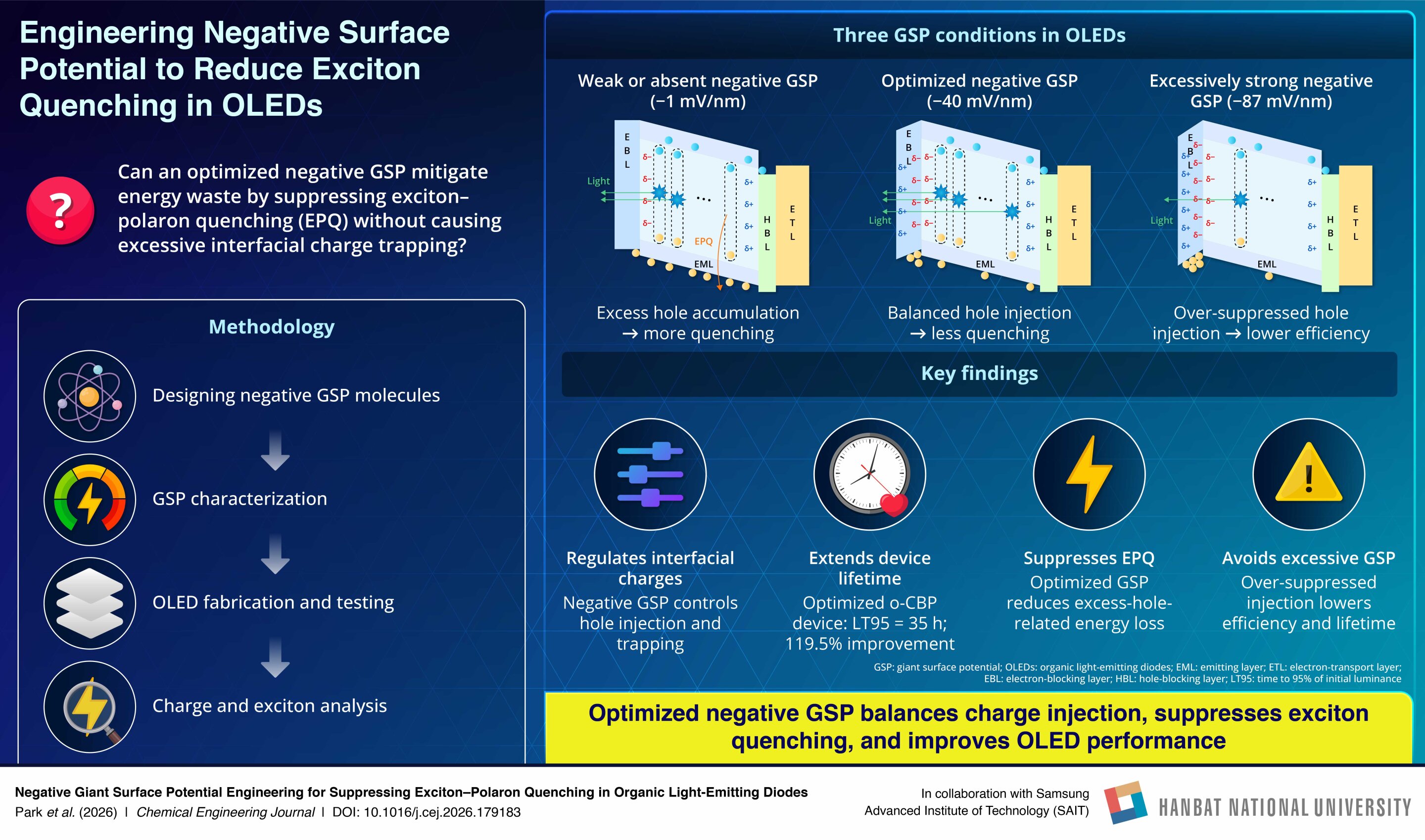
Organic light-emitting diodes (OLEDs) power many display screens, but their efficiency can be limited by energy lost inside the device. As organic layers are deposited, their molecules can align to create an internal electrical potential known as giant surface potential (GSP). When this potential draws excess positive charges, or holes, near the light-emitting layer, they can interfere with light-producing excitons. This process, called exciton–polaron quenching, reduces emitted light and can affect device performance.
A research team was led by professor Jae-Hyun Lee from the Department of Creative Convergence Engineering at Hanbat National University, Republic of Korea, along with Dr. Jong Soo Kim from the Samsung Advanced Institute of Technology. The researchers placed thin electron-blocking layers (EBLs) between the hole-transport and light-emitting layers to adjust the local electrical environment. They compared materials with negative GSP values of −1, −40 and −87 millivolts per nanometer, using electrical measurements, impedance spectroscopy, transient electroluminescence and photoluminescence to examine charge movement and light loss.
This paper was published in the Chemical Engineering Journal on Oct. 1, 2026.
The measurements showed that negative GSP could counter the emitting layer's positive potential and regulate unwanted hole injection. Impedance and transient electroluminescence data revealed that the stronger the negative GSP, the more holes were held at the interface with the emitting layer. The o-CBP layer, with a GSP of −40 millivolts per nanometer, provided the best balance in the tested devices.
Source link