
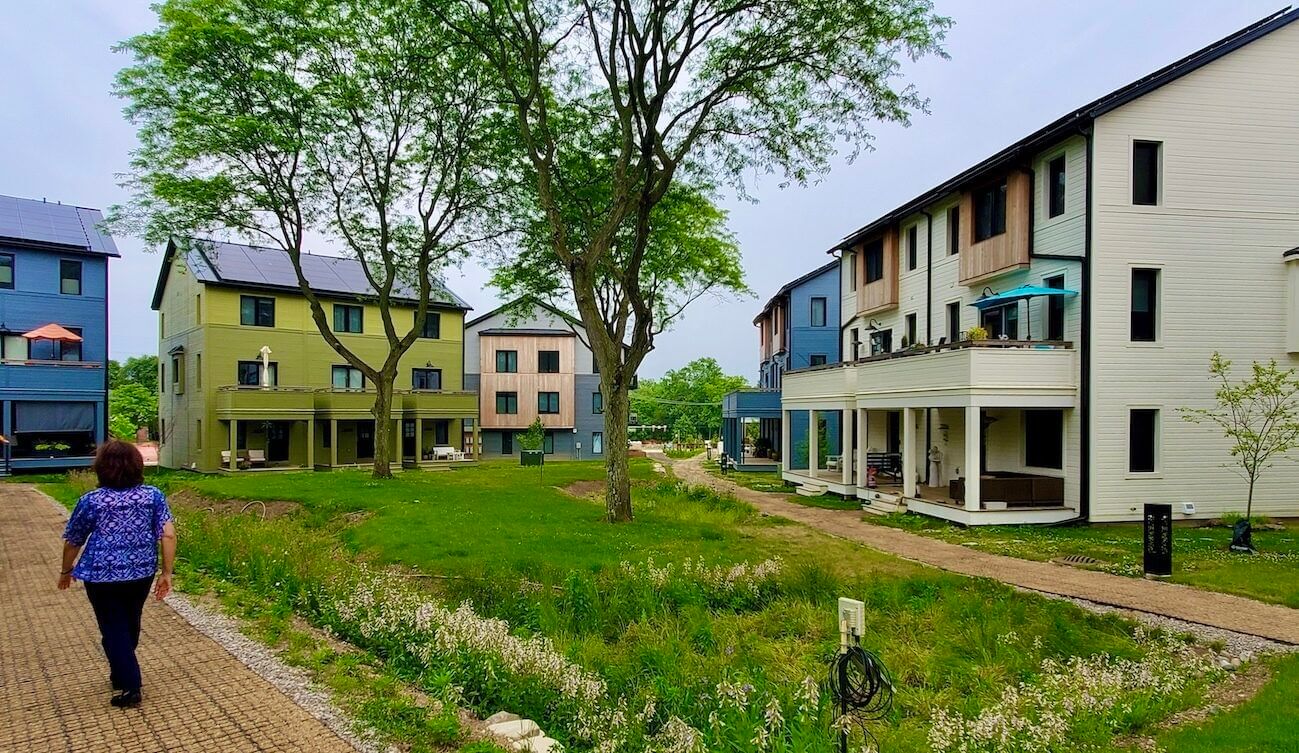
Mitch Hall and his wife, Lori, live in one of the most sustainable communities in the U.S. Their town house is among a few dozen residences constructed so far at Veridian at County Farm, a fossil-fuel-free, net-zero-energy development in Ann Arbor, Michigan. Homes here make about as much solar energy as they consume, with the help of batteries that save solar power for use in the evenings.
Now, the couple is eager to share the benefits of their clean energy infrastructure with the wider grid.
In the coming weeks, Veridian households can enroll in Michigan’s first residential pilot of a virtual power plant; Detroit-based utility DTE Energy will then be able to remotely control the network of residents’ home batteries to inject their stored solar power onto the grid when operators need it most.
“This pilot is an opportunity to test an approach that could ultimately provide a lower-cost way to meet growing energy needs and strengthen reliability,” Joi Harris, president and chief executive officer of DTE Energy, said in a statement. VPPs can smooth out demand peaks, reducing the utility’s need to invest in grid-infrastructure upgrades and generate kilowatt-hours with expensive fossil-fuel peaker plants, both of which would pile costs on consumers.
The initiative “ should work well for the residents, too,” Hall said. ” Because the utility will pull battery power automatically when the grid is strained and electricity prices are likely to be highest, “ a neat part about the virtual power plant is you don’t have to spend a lot of time learning and trying to optimize,” he noted.
Source link





