This article has been reviewed according to Science X's editorial process and policies. Editors have highlighted the following attributes while ensuring the content's credibility:
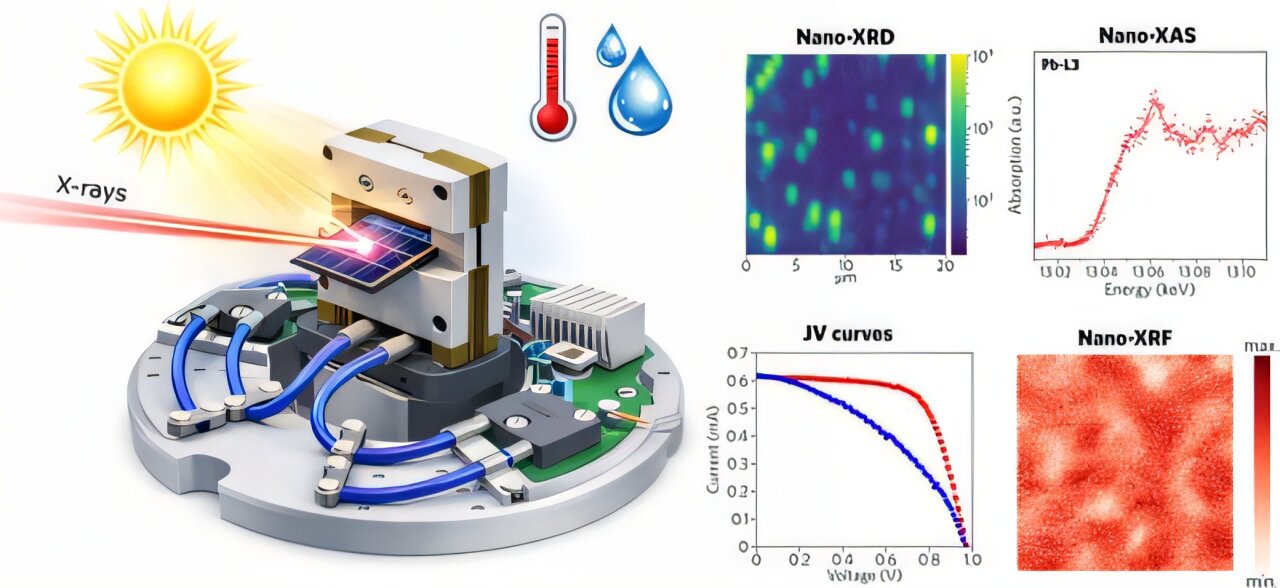
Scientists at the Brazilian Center for Research in Energy and Materials (CNPEM) in Campinas, São Paulo state, developed an instrument for the Sirius particle accelerator that can observe the interior of solar cells on a nanoscale while they are operating. Rather than analyzing isolated components in a laboratory setting, this new platform enables the evaluation of complete devices generating electricity under real operating conditions. It simulates daily exposure to light, heat and humidity.
The team created a system with high mechanical stability to prevent the samples from shifting out of the X-ray beam's focus, even under extreme temperature fluctuations.
Understanding how the atomic structure and chemistry of these materials react to the environment is essential to investigating the causes of their degradation. This technology will be a crucial tool for optimizing emerging solar technologies, such as perovskite cells, paving the way for cheaper, more efficient and more durable solar energy sources.
"We sought to reproduce the normal operating conditions of the solar cell and use the available techniques at the Sirius accelerator to observe what happens within the material," says Rodrigo Szostak, a researcher at the Brazilian National Synchrotron Light Laboratory (LNLS-CNPEM) and the first author of the study published in the journal Photon Science.
As the researcher explains, X-rays offer a key advantage in this type of research. Due to their penetrating power, X-rays allow for examination of the different layers of the device with minimal sample preparation.
Source link