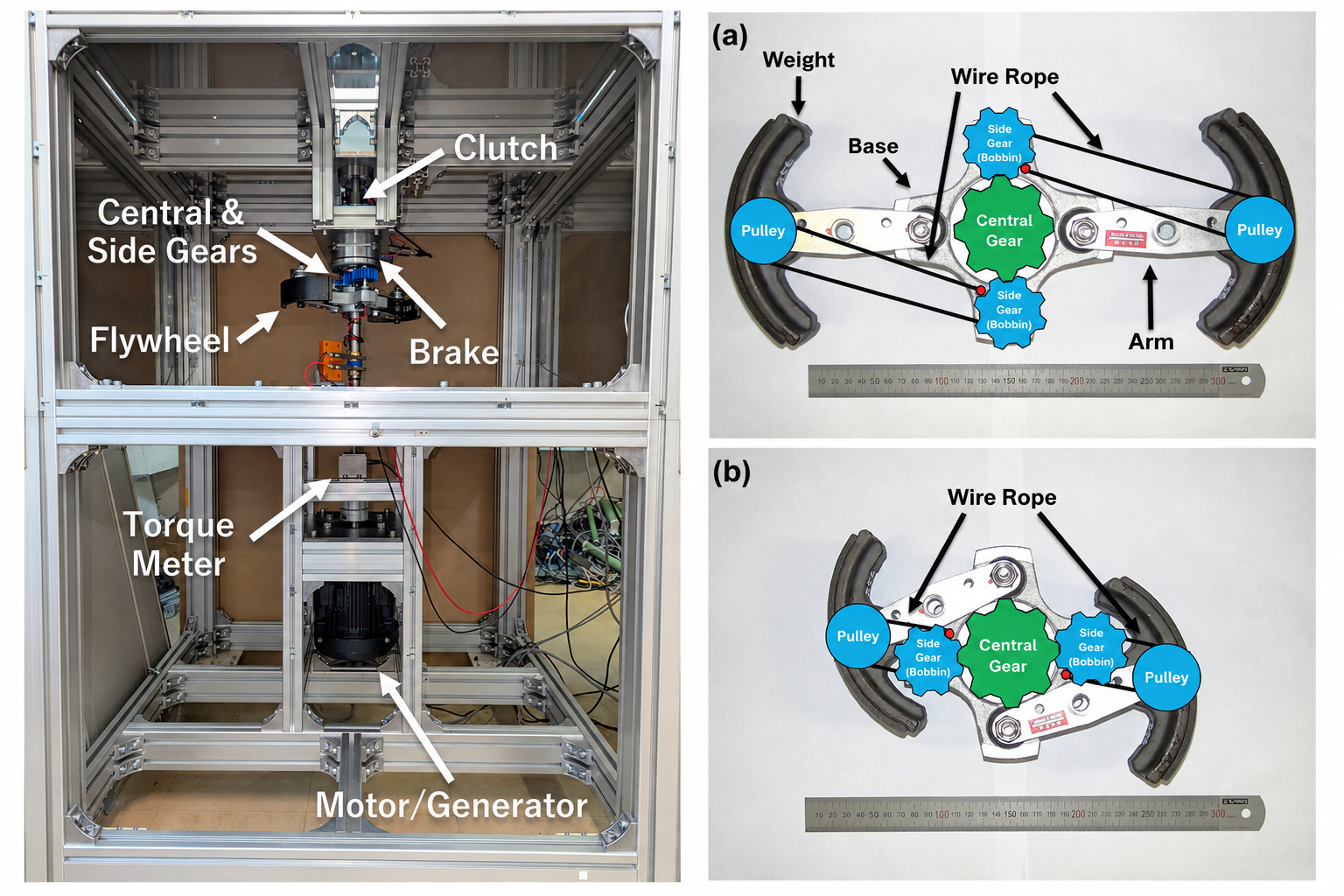
A research team at Tokyo University of Science in Japan has developed and tested a prototype fixed-speed flywheel energy storage system (FESS). Flywheels store energy as rotational motion and suit short-duration applications that require rapid charging and discharging, such as grid frequency regulation. Conventional systems use a power electronic converter to vary the flywheel’s speed while exchanging electricity with the grid. The proposed system moves weights within the flywheel instead of changing its speed, potentially eliminating the converter and reducing costs.
“The main novelty is the development and experimental evaluation of a flywheel mechanism that enables charging and discharging through active changes in its moment of inertia while maintaining an approximately constant rotational speed,” corresponding author Ryoga Sugata told pv magazine. “To our knowledge, experimental studies of such mechanisms remain limited, particularly those that deliberately reduce the moment of inertia to extract stored rotational energy.”
The researcher added that his team developed the design to address losses in their earlier winch- and ball-screw-based mechanisms. “A potential future application is to add controllable active-power storage capability to synchronous condensers. Our longer-term objective is to investigate whether a synchronous condenser can combine its usual reactive-power and inertial support with fast, controllable active-power exchange enabled by the variable-inertia flywheel,” he added.
856 kg weights attached to pivoting arms. They added wire ropes, pulleys, bobbins, gears, an electromagnetic clutch, and a brake to control the weights’ position. 75 kW, three-phase induction machine that acted as both a motor and a generator.
Source link