This article has been reviewed according to Science X's editorial process and policies. Editors have highlighted the following attributes while ensuring the content's credibility:
In a study published in Applied Thermal Engineering, a research team from the Changchun Institute of Optics, Fine Mechanics and Physics of the Chinese Academy of Sciences, together with collaborators, has developed a machine learning–assisted design strategy for a highly selective tungsten-based metasurface absorber and emitter.
By combining artificial intelligence with electromagnetic simulations, the researchers designed a nanostructured surface capable of efficiently absorbing visible and near-infrared light while controlling thermal emission, offering a promising approach to improving solar thermophotovoltaic energy conversion.
Efficient solar energy conversion requires materials that can capture sunlight across a broad wavelength range while minimizing unwanted energy losses. Solar thermophotovoltaic systems convert absorbed sunlight into heat, which is then emitted as thermal radiation that can be converted into electricity by photovoltaic cells. However, conventional absorbers often have limited spectral selectivity, are sensitive to incident angles and show reduced performance under demanding operating conditions.
Designing nanostructures that can overcome these limitations simultaneously remains challenging, especially since extensive numerical simulations are often necessary to optimize their optical properties.
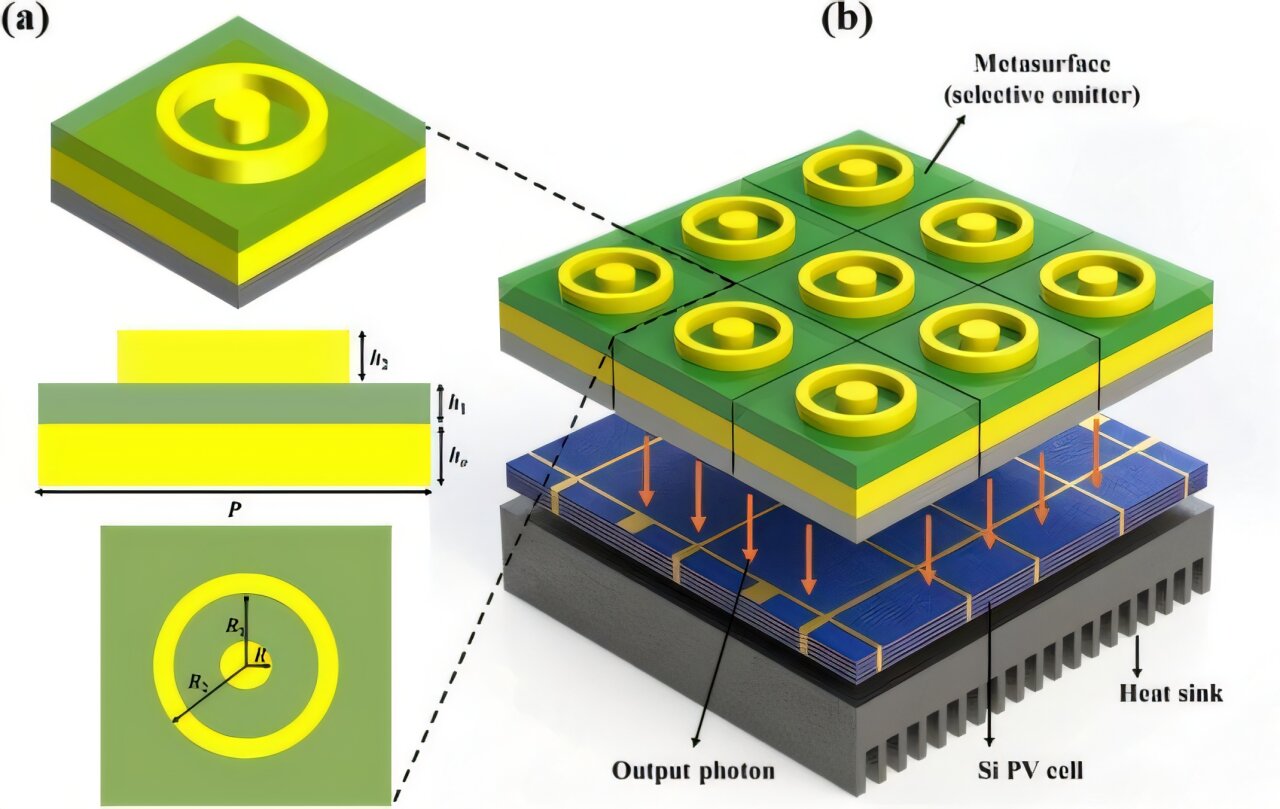
To address these challenges, the researchers designed a tungsten-based metasurface consisting of a metal–insulator–metal structure with carefully arranged nanoscale resonators. They selected tungsten for its favorable optical absorption characteristics and its suitability for high-temperature applications.
The researchers used a combination of finite-difference time-domain simulations and machine learning to study the influence of different structural parameters on light absorption.
Source link