
How the Franco-German auto deal, a wide Made-with-EU scope, and carmakers abandon Europe’s battery value chain to foreign competitors.
There is a growing consensus that Europe must reduce its reliance on Chinese cleantech, especially batteries
The IAA marks a major shift in EU industrial policy. It introduces Union content incentives to ensure scarce public subsidies and corporate tax incentives are used to support European manufacturing. This demand-side pull is crucial if the energy transition is to deliver high-value industrial jobs and lessen critical geopolitical dependencies. There is a growing consensus that Europe must reduce its reliance on Chinese cleantech, especially batteries. But several proposals currently before co-legislators risk severely undermining that overarching goal. Diluting battery criteria in the IAA means giving up on a strategic value chain for Europe, leaving it to China only.
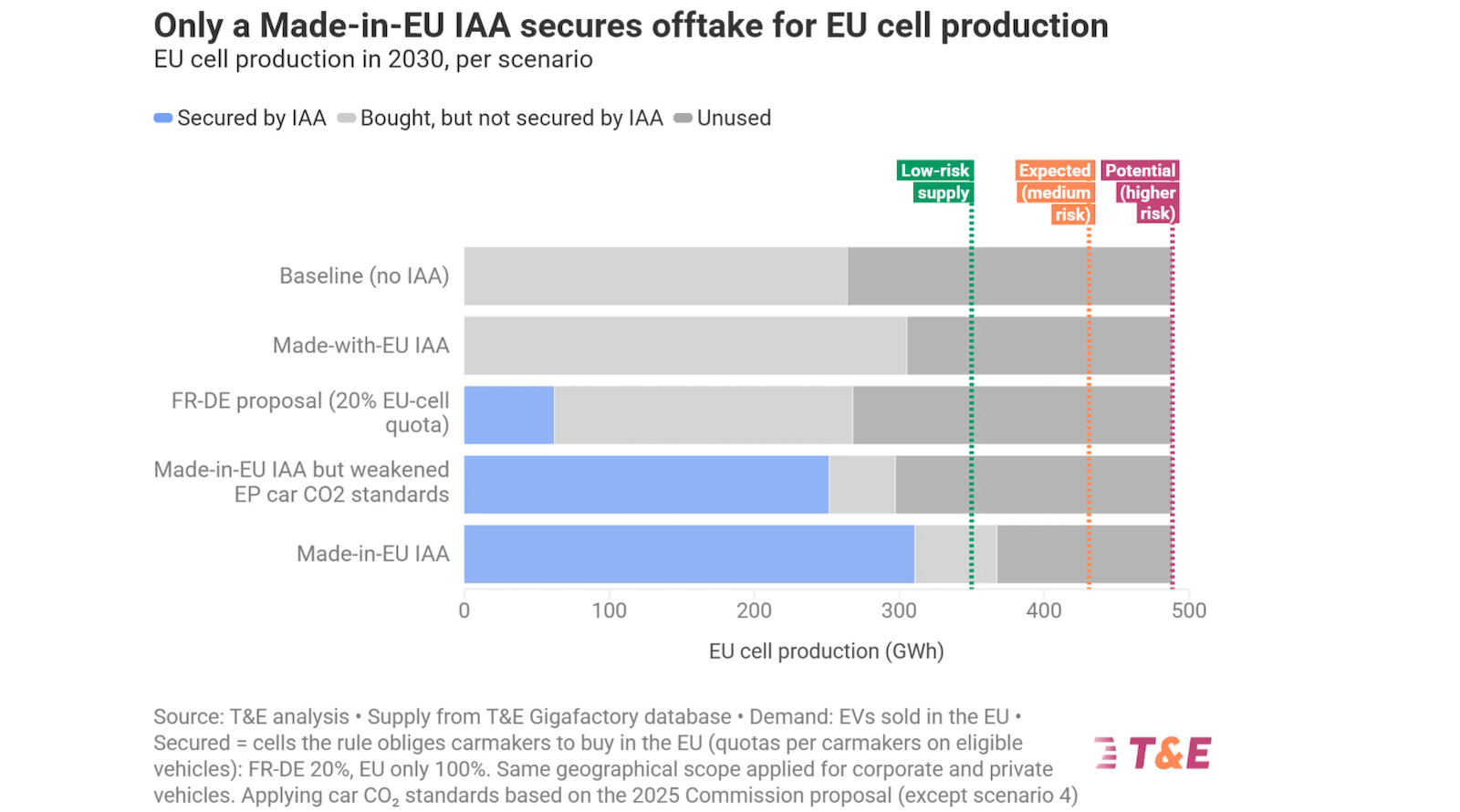
T&E’s assessment shows that only an IAA with a calibrated timeline, robust battery requirements and a strict geographical scope will deliver substantial benefits for Europe. Without secured demand, announced industrial capacity will simply not materialise.
The Franco-German automotive deal from 16 October 2026 is a major blow for Europe’s battery industry as it severely dilutes incentives for batteries. It suggests battery sourcing requirements for eligible vehicles of 10% in 2028-2029, 20% in 2030-2031 and 70% from 2032 on. This is far below what the market already does: over 50% of cells in electric vehicles (EVs) sold in the EU are already Made-in-Europe. By 2030, the deal would only secure 13% (62 GWh) of Europe’s announced cell production: a further 206 GWh would likely find European buyers, though with no guarantee, while 220 GWh would find no demand at all.
Source link