

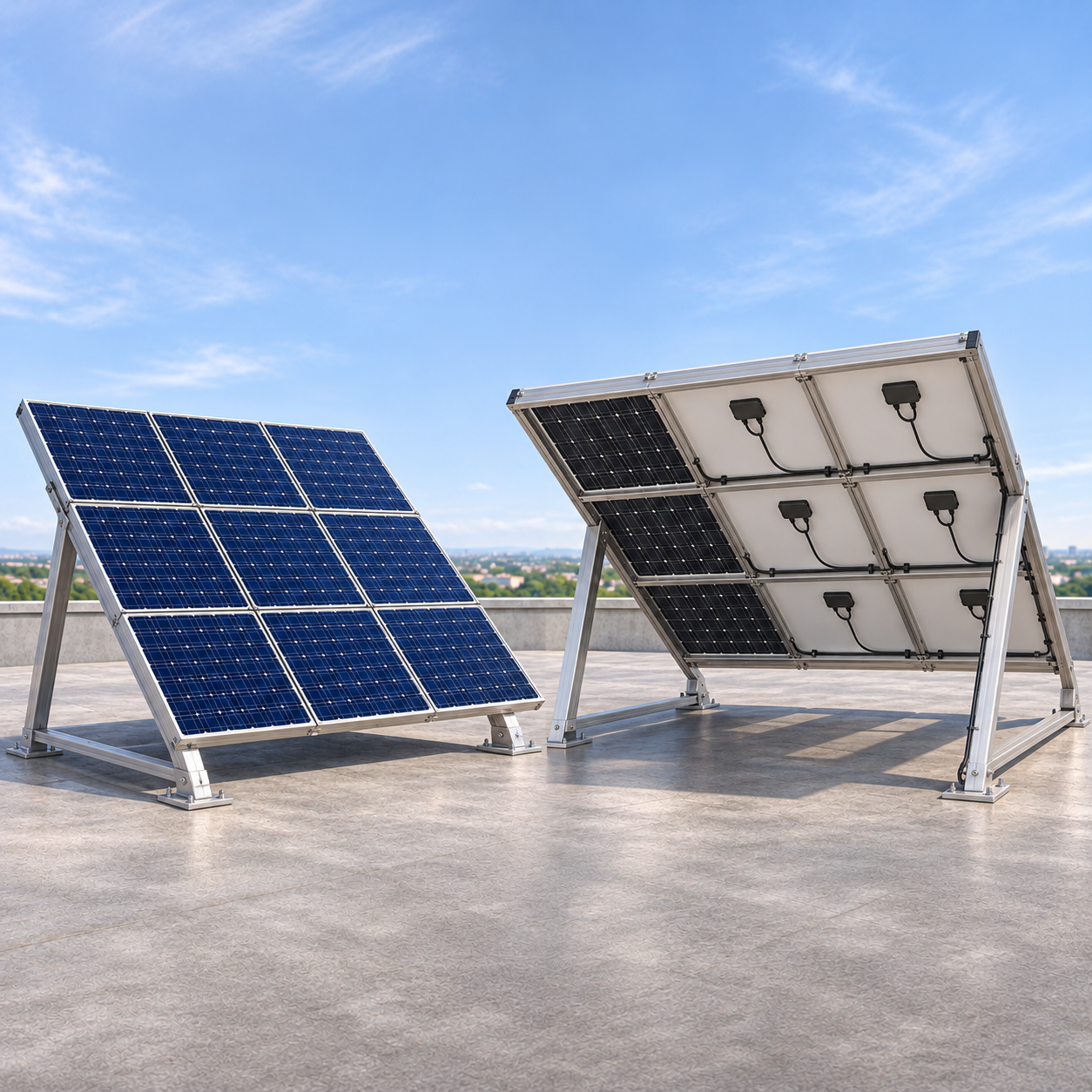
A research team in India has experimentally investigated the performance of a photovoltaic array combining monofacial and bifacial solar modules.
“To mitigate power increase and cost, a hybrid PV array arrangement incorporates a small number of bifacial modules within a traditional monofacial array,” the researchers said. “Employing a switching matrix-based reconfiguration approach, the most effective hybrid configuration was dynamically selected.”
The researchers tested different configurations of a 3 × 3 PV array to determine how to increase power output while limiting costs.
They assembled a 3 × 3 PV array with nine modules electrically connected in a total-cross-tied configuration. They first measured the voltage, current, and power output of a reference array comprising nine 10 W monofacial modules. They then replaced three of the modules with 12 W bifacial modules to create a hybrid array.
The team tested six configurations, placing the three bifacial modules in different positions: diagonally in the top-left, center, and bottom-right positions; across the top row; down the leftmost column; in the center and the two bottom corners; in the top-right and two bottom corners; and in the top-middle, top-right, and bottom-right positions. The remaining six positions in each configuration were occupied by monofacial modules.
The researchers conducted rooftop experiments at Kamaraj College of Engineering and Technology in southern India under 12 irradiance conditions: no shading, uneven column shading, uneven row shading, diagonal shading, plus-shaped shading, center shading, corner shading, outer shading, short-and-wide shading, long-and-wide shading, left-corner shading, and random shading.
They compared the electrical performance of each hybrid configuration with that of the all-monofacial reference array.
Source link





