This article has been reviewed according to Science X's editorial process and policies. Editors have highlighted the following attributes while ensuring the content's credibility:
Solar panels that can be coated onto thin, flexible surfaces could one day be made the way newspapers are printed, at room temperature and without the toxic chemicals the process has relied on, claim researchers from the University of Surrey.
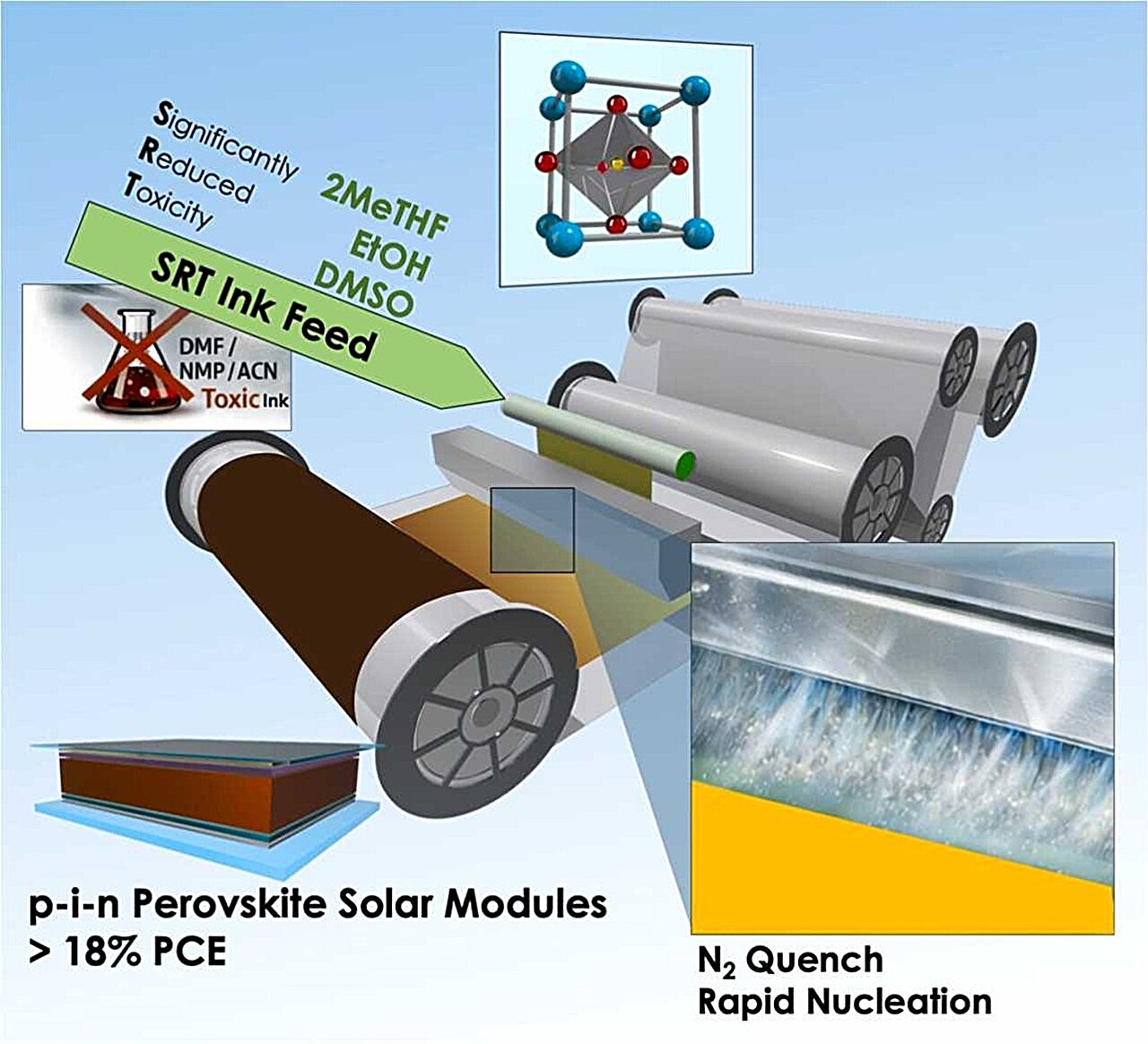
In a paper published in the journal Nano Energy, scientists set out a lower-toxicity way to make perovskite solar modules at the scale a factory would need. Perovskites are a leading candidate to sit alongside or replace conventional silicon solar cells, because they can be dissolved into an ink and coated onto lightweight, bendable surfaces. The problem for perovskites is that the ink itself depends on solvents that are hazardous to handle and costly to manage on a production line.
The Surrey research team produced their ink around safer ingredients. Their system, which they call a significantly reduced-toxicity (SRT) solvent, is based on ethanol and 2-methyltetrahydrofuran, a solvent derived from renewable sources such as farm and forestry waste, with a small amount of a milder additive to control how the film forms. It removes the need for the toxic solvents the field has long leaned on, including dimethylformamide (DMF), N-methyl-2-pyrrolidone (NMP) and acetonitrile (ACN), several of which are classed as reproductive toxins.
The researchers note that producing a gigawatt of electricity from these perovskite modules can consume more than 90,000 liters of solvent on a single coating line, so cutting toxic solvents out of the ink removes a real health and environmental burden from manufacturing.
Source link