
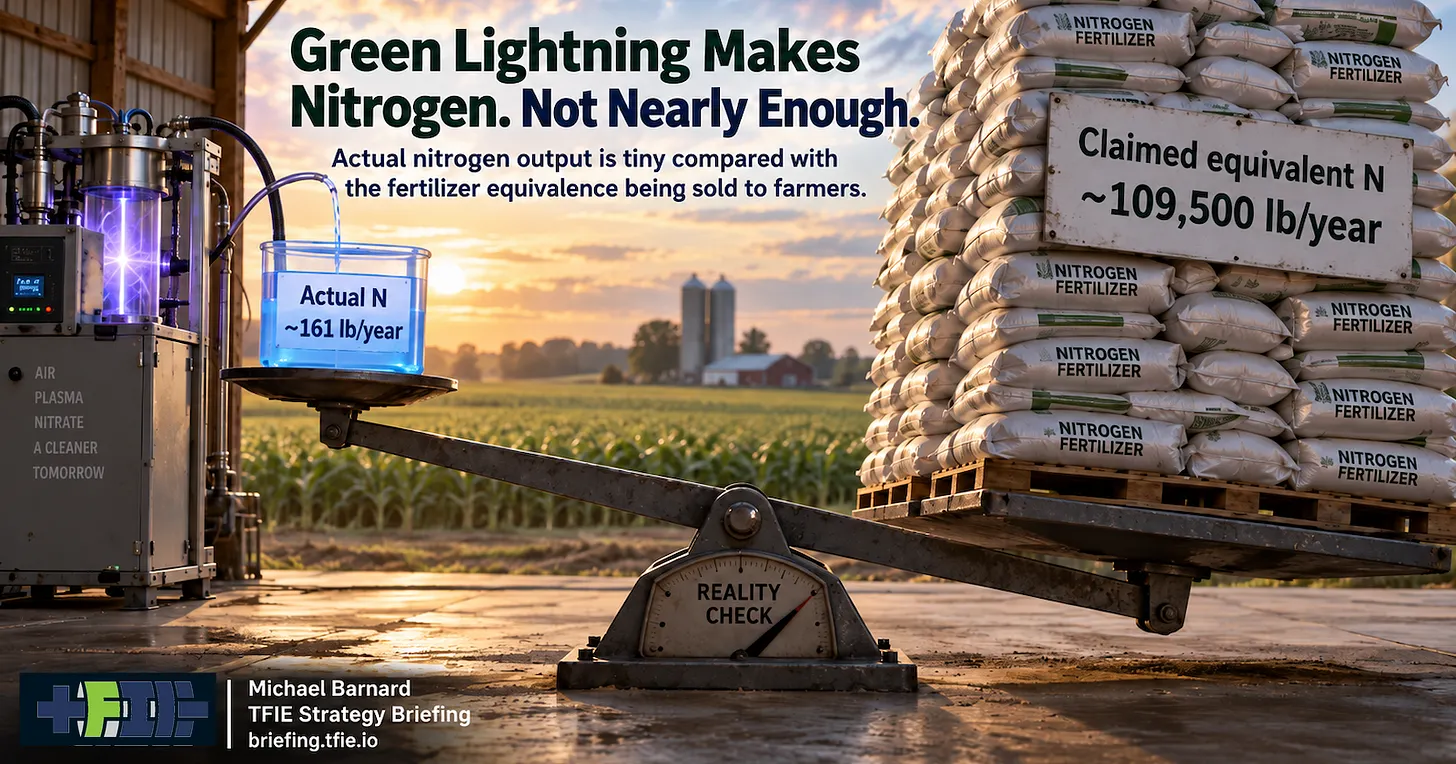
Green Lightning really does make nitrogen fertilizer from air and electricity, but it makes very little of it compared with what its marketing says it can replace. Nitrogen is not merely something that encourages a plant to grow. Nitrogen atoms become part of the plant itself, incorporated into proteins, chlorophyll, DNA and other cellular material. Conventional fertilizers such as urea and urea-ammonium nitrate, commonly called UAN, supply those atoms in forms crops can use. At the nitrate concentration reported by Washington State University Extension, a Green Lightning machine producing 100 gallons a day would fix about 161 pounds of actual nitrogen per year. The product has also been described as equivalent to about three pounds of conventional nitrogen per gallon, which at the same production rate comes to 109,500 pounds of claimed conventional-nitrogen replacement per year.
That is roughly a 680-fold difference between nitrogen physically created by the machine and nitrogen supposedly replaced in the field. Fertilizer efficiency can certainly be improved. Better timing, placement and application can reduce losses, and farmers routinely get more useful crop growth from a pound of nitrogen by managing it better. None of those improvements create nitrogen atoms. If a crop maintains its yield after a large amount of conventional fertilizer is removed while Green Lightning supplies only a small amount of new nitrogen, the remainder has to come from soil organic matter, residual fertilizer, manure, previous crops or some other source already present in the field.
The full TFIE Strategy Briefing analysis follows that missing nitrogen through the soil, tests whether claims of higher nitrate concentrations materially change the arithmetic, checks the plasma-energy numbers and works through the independent field evidence.
Source link