
This article has been reviewed according to Science X's editorial process and policies. Editors have highlighted the following attributes while ensuring the content's credibility:
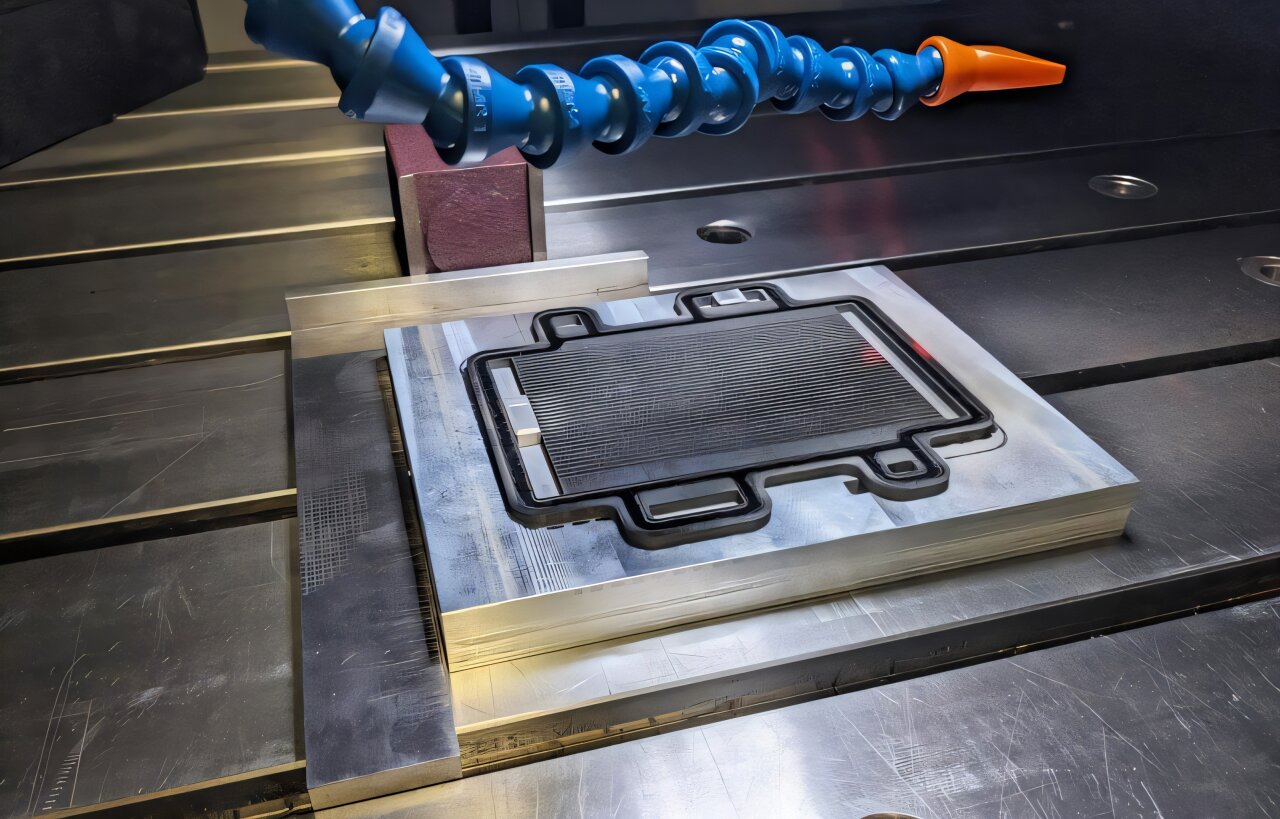
In the StruBiPlate research project, Fraunhofer IWU investigated new manufacturing and structuring approaches for particularly lightweight bipolar plates made from carbon fiber-reinforced polymer (CFRP).
Fuel cells generate electricity from hydrogen and oxygen in the air, continuously supplying energy to an electric propulsion system. For aerial mobility applications, weight and packaging space of a fuel cell system are critical. This is where the StruBiPlate collaborative project comes in: the goal was to develop novel, extremely lightweight fiber-composite bipolar plates with microstructured surfaces that perform electrical and fluid-flow functions.
Bipolar plates perform several functions simultaneously in a fuel cell stack. Among other things, their fine channel structures distribute the reactants and coolant. In the StruBiPlate project, the researchers therefore examined existing metallic bipolar plates and their characteristic channel geometries, as well as graphite bipolar plates as starting points for developing new structures.
In practice, metal and graphite represent two fundamentally different material concepts. Metallic bipolar plates primarily offer low component thickness, mechanical robustness and excellent suitability for industrial manufacturing.
By contrast, graphite offers good electrical conductivity and high chemical resistance in the fuel cell environment, but its mechanical properties require comparatively thick walls. For applications where weight is critical, this raises an interesting question: Can a new design combine the strengths of both approaches?
Carbon fiber-reinforced polymers offer considerable design freedom. CFRP combines high strength with low weight.
Source link





