
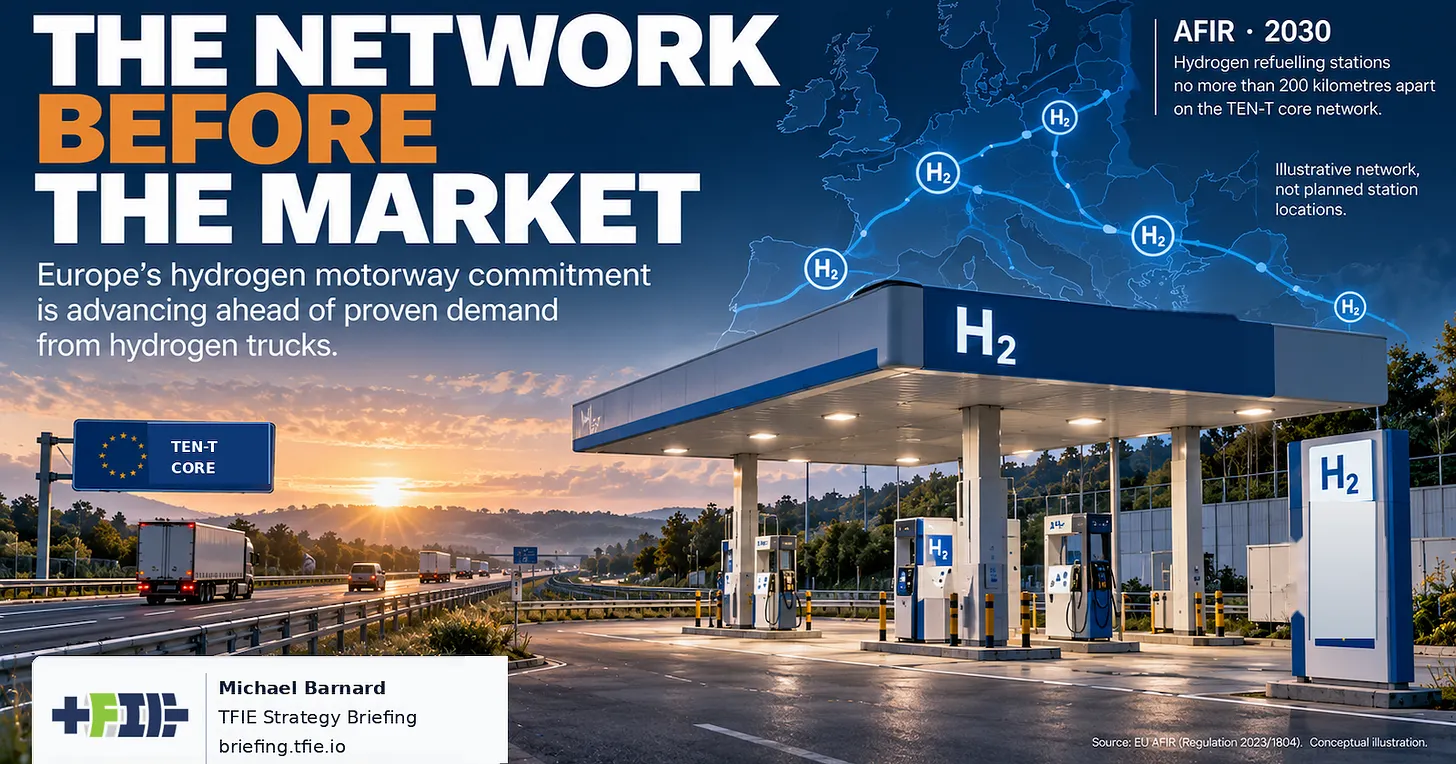
Europe is building a hydrogen-refuelling network before there is a large hydrogen-truck market to support it. Under the Alternative Fuels Infrastructure Regulation, hydrogen stations are supposed to be available along major motorway corridors at intervals of no more than 200 kilometres by 2030, with additional coverage at designated urban nodes. A European assessment estimates that an AFIR-compliant network could require roughly €2.1 billion of capital investment.
The policy logic is understandable. Truck operators are unlikely to buy hydrogen vehicles if they cannot refuel them reliably across borders, while station investors are reluctant to build without customers. The problem is that Europe is not the first jurisdiction to try solving that coordination problem by pushing infrastructure ahead of demand. South Korea has already run a much more mature version of the experiment, and its station economics should be treated as a warning.
I examine that comparison in Europe’s Hydrogen Highway Gamble. The deeper analysis looks at South Korea’s operating subsidies, the strongest break-even case, hydrogen supply economics and what Europe should require before committing further AFIR capital.
By August 2026, South Korea had installed 493 hydrogen refuelling units, reaching 74.7% of its target of at least 660 by 2030. Hydrogen vehicle registrations were much further behind at 49,220, only 16.4% of the government’s 300,000-vehicle target. Those figures are not utilization rates, but they show that the policy programme succeeded much more rapidly at constructing infrastructure than at creating the customer base intended to support it.
Source link