
Ontario Power Generation has acknowledged that its first GE Vernova Hitachi BWRX-300 small modular reactor at Darlington will exceed its C$7.7 billion approved budget and miss its October 2030 commercial-operation target. There is no replacement cost or completion date yet. OPG expects its engineering, cost and schedule review to be substantially complete by mid-2027.
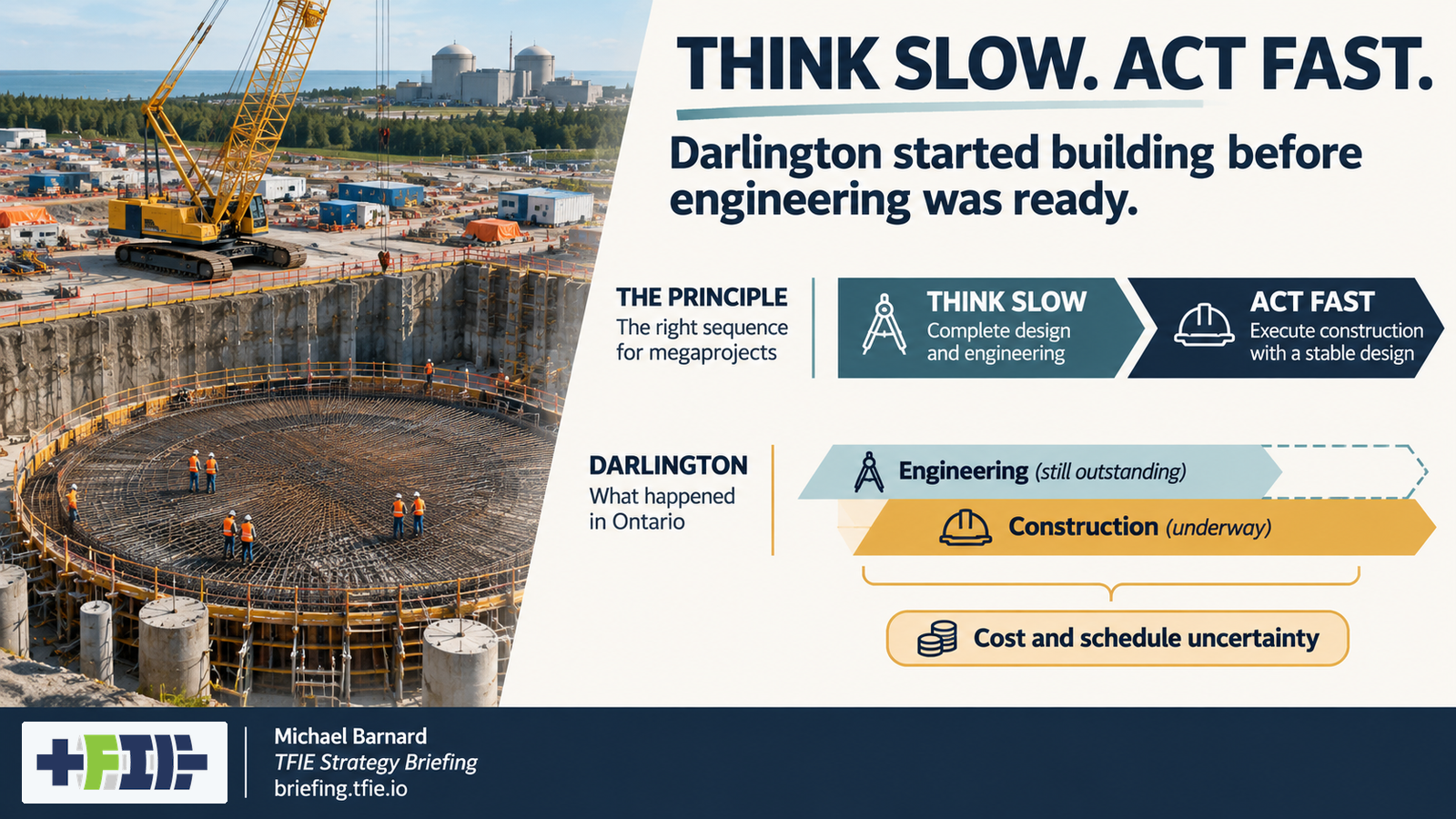
The reason matters. In its November 10 financial results, OPG identified continuing first-of-a-kind reactor engineering and its effects on construction execution and supply-chain performance. Ontario started physical work while parts of the design governing that work were still evolving. The project is now living with the consequence.
This is not a story about a construction crew failing to install a basemat. The 2.1-million-pound reactor foundation is in place, work on the turbine building has progressed, and the cooling-water tunnel equipment has been assembled. These are real achievements. They do not settle the engineering dependencies, supplier requirements and delivery sequence for a first-of-a-kind reactor. Construction progress and schedule certainty are different things.
Megaproject researcher Bent Flyvbjerg calls the better approach “think slow, act fast.” Engineering, interfaces and execution plans need enough maturity that construction can advance without a succession of disruptive changes. Design and construction can overlap on controlled, ready-to-build work packages. Darlington’s own disclosure shows that the required boundary has not been maintained.
My TFIE Strategy Briefing on Darlington’s SMR examines the November disclosure, the historical nuclear construction record and the consequences for Ontario’s four-reactor plan.
Source link