This article has been reviewed according to Science X's editorial process and policies. Editors have highlighted the following attributes while ensuring the content's credibility:
Hydrogen's ability to power a cleaner future hinges not only on finding materials capable of efficiently storing and releasing it, but also on understanding the trade-off between storage capacity and practical operating conditions.
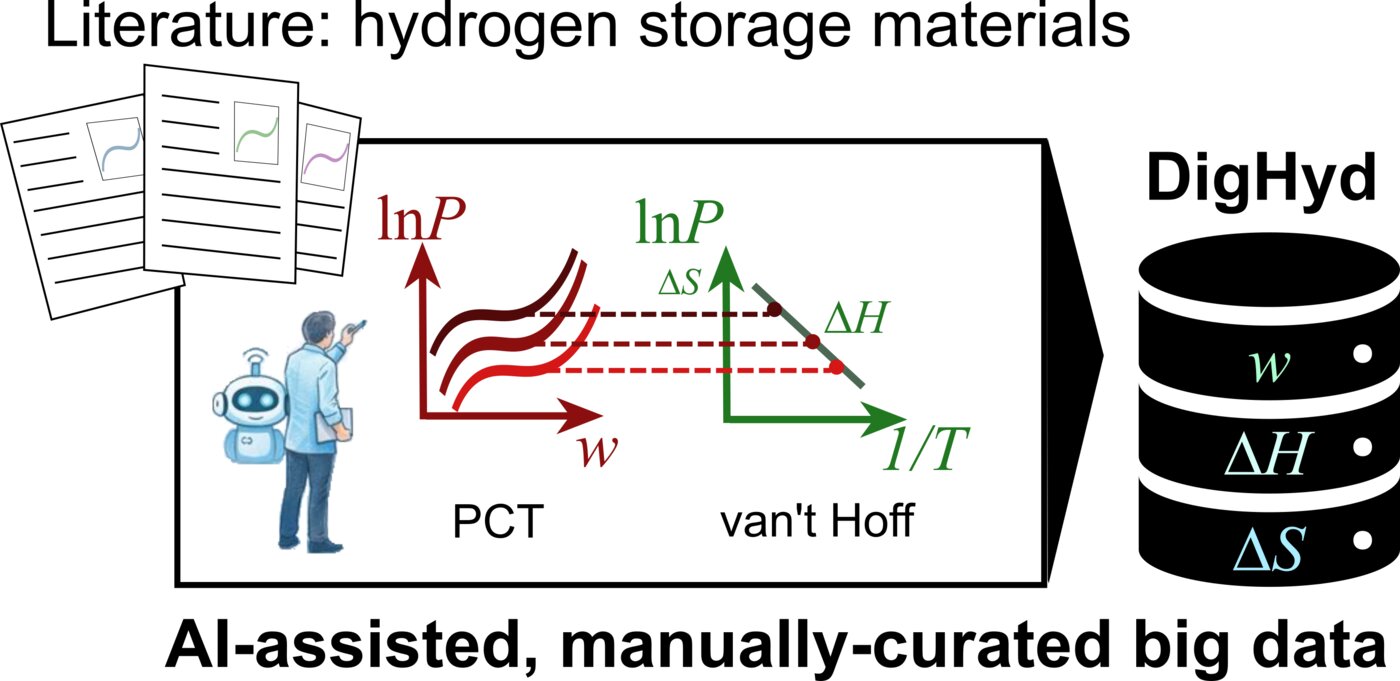
A research team led by Tohoku University, in collaboration with the University of Tokyo, developed the Digital Hydrogen Platform (DigHyd), a curated database containing more than 30,000 data entries from over 4,000 experimental publications. The paper is published in the journal Applied Physics A.
Using this resource, the team created a physical map linking material properties to hydrogen storage capacity and equilibrium pressure, which helps determine the conditions under which materials absorb and release hydrogen.
"Understanding hydrogen storage requires more than finding materials that can hold large amounts of hydrogen. We need to understand why their properties determine how hydrogen is retained and released. By combining reliable experimental data with interpretable AI, we can begin to uncover these underlying physical relationships," says Hao Li, distinguished professor at the Advanced Institute for Materials Research (WPI-AIMR), Tohoku University.
Building a reliable database required more than automated data collection. The team combined AI-assisted literature mining with careful human validation, checking extracted information against original publications, standardizing units and analyzing experimental curves.
For metal hydrides, materials that store hydrogen within their structures, the researchers manually curated 4,643 storage-capacity measurements and 652 pairs of enthalpy and entropy measurements.
Source link