Open-access carbon dioxide terminal venture CO2next – a partnership comprising Gasunie, Royal Vopak, Shell, and TotalEnergies at the Maasvlakte in the Port of Rotterdam – has completed its Front-End Engineering Design (FEED) phase, establishing a validated engineering baseline as the project advances toward procurement tendering and a Final Investment Decision (FID).
Executed in collaboration with engineering partner Sener Ingeniería y Sistemas S.A. (Sener), the FEED workstream finalized technical specifications, operational safety systems, and quantitative risk assessments for the liquid CO2 reception and export hub.
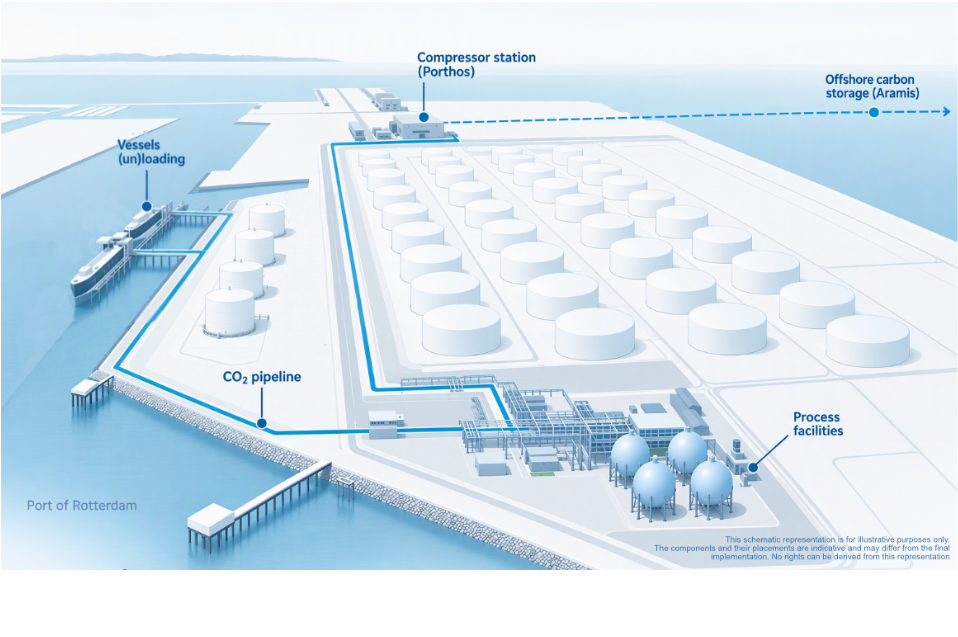
In its first development phase, the terminal will comprise two marine jetties, each outfitted with three Marine Loading Arms (MLAs) to offload liquefied CO2 from specialized transport vessels, alongside four intermediate storage tanks and a multi-stage low- and high-pressure pumping system.
Because offshore trunk pipelines and geological reservoirs require steady injection profiles, the terminal’s four storage tanks are engineered to act as an operational buffer, smoothing out intermittent marine cargo arrivals into a continuous, pressurized export stream feeding directly into the Aramis offshore transport infrastructure for permanent sequestration in depleted North Sea gas fields.
To accommodate growing European industrial capture volumes, the terminal layout reserves physical space for a third jetty, extra storage tanks, ship reloading capabilities, and potential rail reception infrastructure, enabling initial throughput capacity of 5.4 million tons per annum (Mtpa) to scale to 10 Mtpa in subsequent expansion phases.
Relevant: CO2next Launches Market Call For Rail CO2 Delivery To Rotterdam Terminal
To limit scope 1 and 2 facility emissions, the project incorporates electrically driven construction machinery alongside onshore power supply connections allowing moored CO2 carriers to shut down auxiliary engines while alongside.
Source link