
China spent much of the 2010s electrifying urban bus fleets while most countries were still testing whether battery-electric buses could replace diesel. By the end of 2025, it had 551,400 new-energy urban buses, representing 87.5% of the fleet. That early success has brought China to a stage other countries will encounter later, when large numbers of batteries reach the end of their automotive service and owners must decide what to do with them.
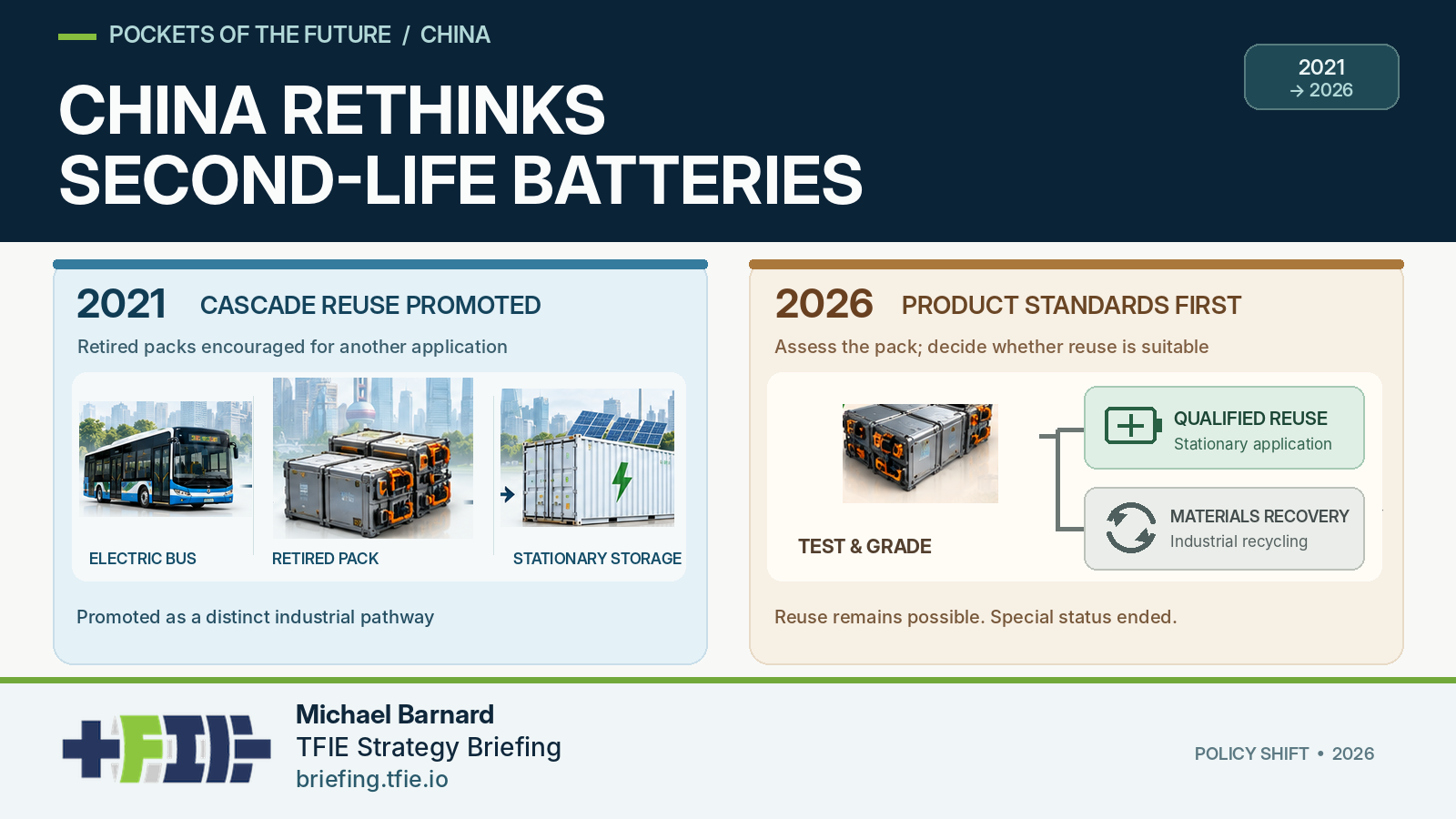
In 2021, Chinese policy encouraged companies to give retired EV batteries a second life in stationary energy storage, backup power and charging infrastructure. The idea was attractive. A battery that had lost enough capacity to become less useful in a vehicle could still store substantial electricity, potentially avoiding the manufacture of another battery.
China has now changed its regulatory approach. New rules effective in April 2026 repealed the earlier cascade-utilization framework. A July 30 announcement from the Ministry of Industry and Information Technology withdrew special recognition for cascade-utilization companies and directed industry associations to discontinue promotional activities associated with the category.
Some reporting has described this as China banning second-life batteries. That misrepresents the change. Retired vehicle batteries can still be used in suitable applications when the resulting products meet the applicable standards. Reuse in electric bicycles and other restricted applications is prohibited. The ministry’s stated concern is the safety of inadequately tested, reassembled batteries with varying remaining capacity and inconsistent cell condition.
China’s experience deserves attention because battery retirement is becoming an industrial activity rather than a small collection of pilot projects.
Source link