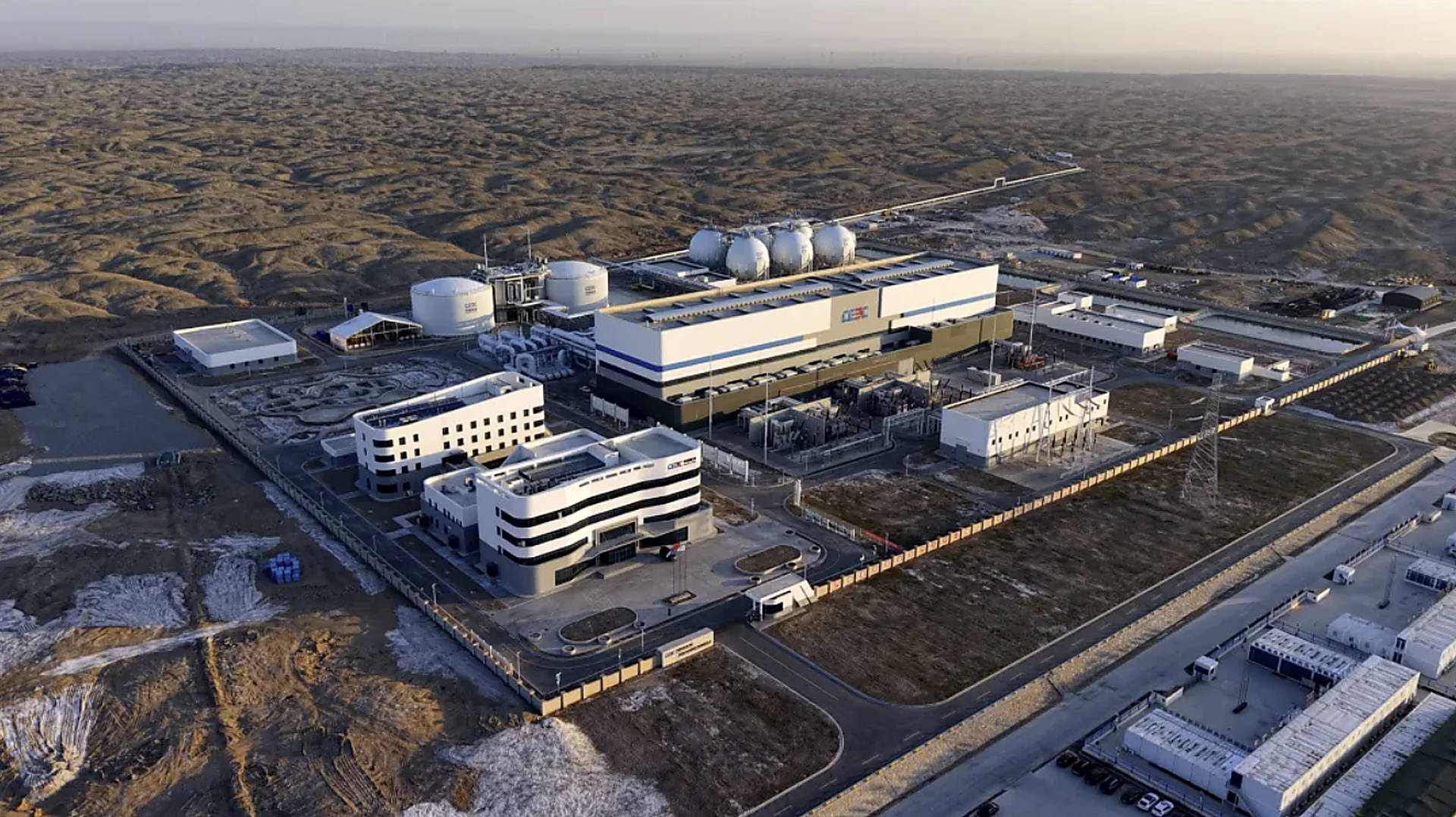
China’s Yuanchu No. 1 compressed air energy storage (CAES) station in Yumen, Gansu province, achieved its first grid connection on November 16, marking what its developer describes as the world’s first grid-connected CAES facility using purpose-excavated underground rock caverns.
The project was developed by China Energy Digital Technology Group, a subsidiary of China Energy Engineering Corporation, which is responsible for its investment, construction, and operation.
Rated at 300 MW/1,800 MWh, the facility is designed for an eight-hour charging cycle and six hours of continuous discharge. Total investment reached approximately CNY 2.5 billion ($368 million), with projected annual electricity generation of 600 GWh.
Its defining feature is an engineered underground air storage system. Four interconnected chambers were excavated approximately 110 meters below the surface in hard rock, creating a pressurized storage space of around 200,000 cubic meters. The system has a design pressure of 18 MPa.
The plant employs non-combustion, adiabatic CAES technology. During charging, electricity drives compressors that pressurize air, while heat generated during compression is recovered and stored. During discharge, the stored heat reheats the compressed air before expansion through turbines, eliminating the need for supplementary natural gas combustion.
According to molten-salt supplier Shandong Huayang Dier Chemical, the thermal system combines low-melting-point ternary molten salt with pressurized hot water to recover and store heat at different temperatures. Lower- and medium-temperature compression heat is stored in pressurized water tanks, while higher-temperature heat is transferred to molten-salt tanks. During discharge, both media release heat in stages to reheat the air before expansion.
Source link