This article has been reviewed according to Science X's editorial process and policies. Editors have highlighted the following attributes while ensuring the content's credibility:
Look around and count your devices that need power: the watch on your wrist, the sensors in your car, the tags tracking packages across the country. Billions more are coming as the Internet of Things grows. Most will be small, many will be flexible, and nearly all will need somewhere to store energy. We think the best place to put that storage is right on the circuit, printed alongside everything else.
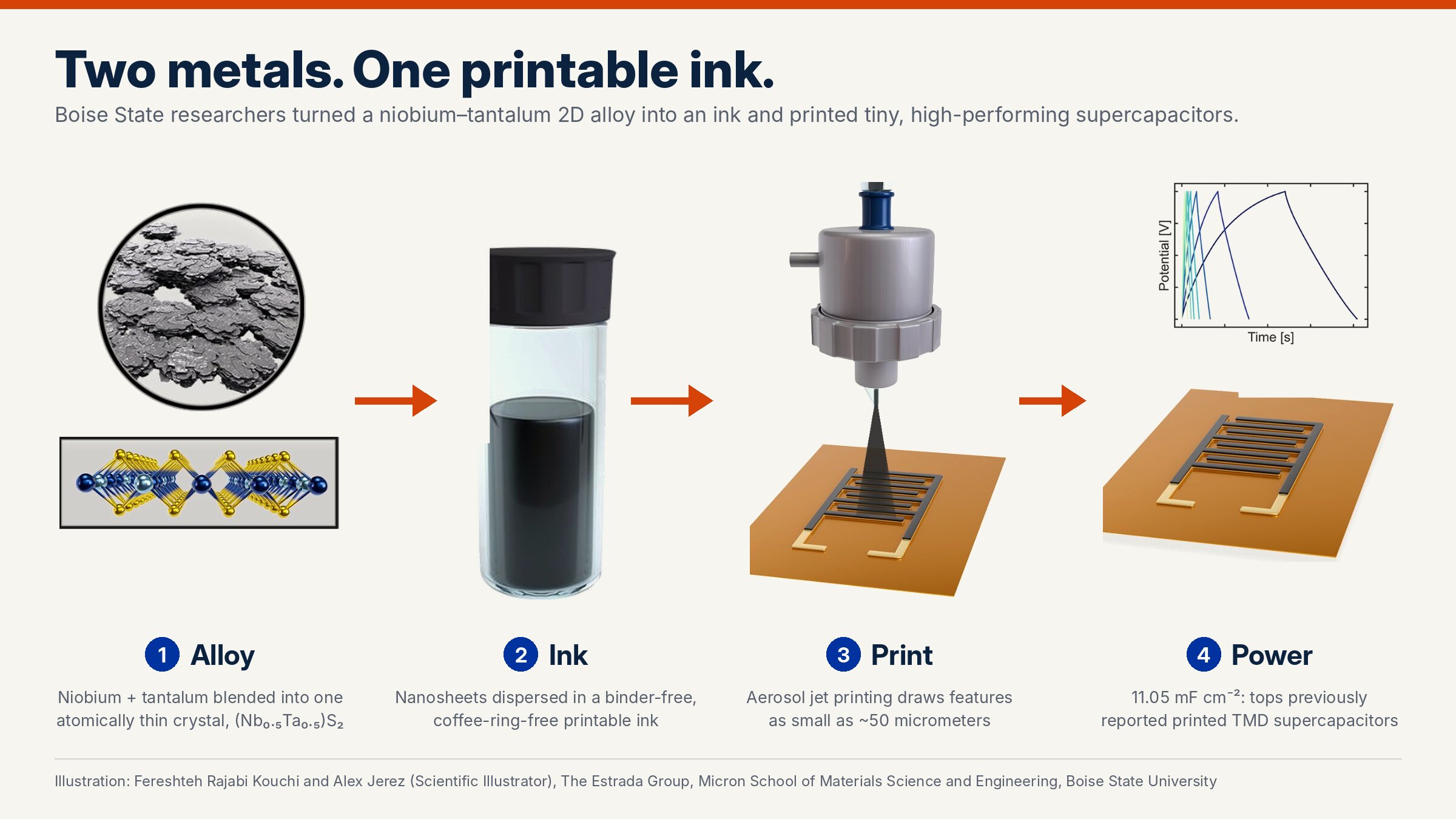
That idea drives much of our lab's work. We use aerosol jet printing, which turns a liquid ink into a fine mist and focuses it into a narrow stream, like a precision airbrush. It lets us draw electronic devices directly onto plastic, paper, or glass. But the printer is only half the story. The ink is the other half, and inks made from new materials are where the hard problems live.
Our material belongs to a family called transition metal dichalcogenides, or TMDs. Picture a stack of paper where each sheet is only a few atoms thick: a layer of metal atoms sandwiched between layers of sulfur. Because the sheets are so thin, almost every atom sits on a surface where it can interact with ions. That is exactly what you want in a supercapacitor, a device that stores energy by collecting ions at an electrode surface and charges and discharges far faster than a battery.
Source link