Aquarry, a Colorado-based deep tech climate startup working on an innovative mine remediation technology, announced that its operations have officially advanced from lab-level work to a pilot deployment in Wyoming.
The company specializes in a carbon dioxide removal (CDR) approach that dissolves alkaline mine waste into pit lakes at former mines, boosting the water’s CO2 absorption and supporting a process that locks atmospheric carbon away as solid carbonate rock.
Last year, Wren launched a special Slingshot fundraiser in support of Aquarry’s technology, successfully raising $248,906 to help advance operations from research to field deployment.
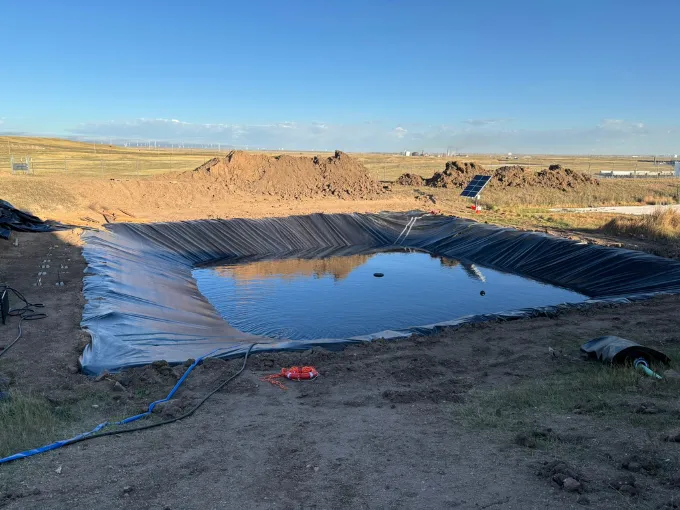
Having achieved strong lab and model results throughout the past year, Aquarry has now entered into the next growth stage, installing a pilot deployment in Wyoming, which will serve to monitor performance in real-world conditions.
Through this deployment, its team will track how factors such as wind, rain, UV, native microbes, and temperature affect the CO2 uptake and mineralization, and it will assess the long-term impact of this approach on water quality.
In the future, Aquarry plans to deploy this technology at the Atlantic Carbon Mineral Hub in Baie Verte, in the Canadian province of Newfoundland.
Once positioned among the world’s largest asbestos exporters, Canada is now home to large abandoned asbestos mines. Baie Verte specifically holds 50 million tonnes of asbestos tailings and an additional 250 million tonnes of waste rock.
Due to its high magnesium content, asbestos is a great alkaline mineral feedstock for Aquarry’s process, which is entirely wet and avoids any harmful dust generation.
Source link