This article has been reviewed according to Science X's editorial process and policies. Editors have highlighted the following attributes while ensuring the content's credibility:
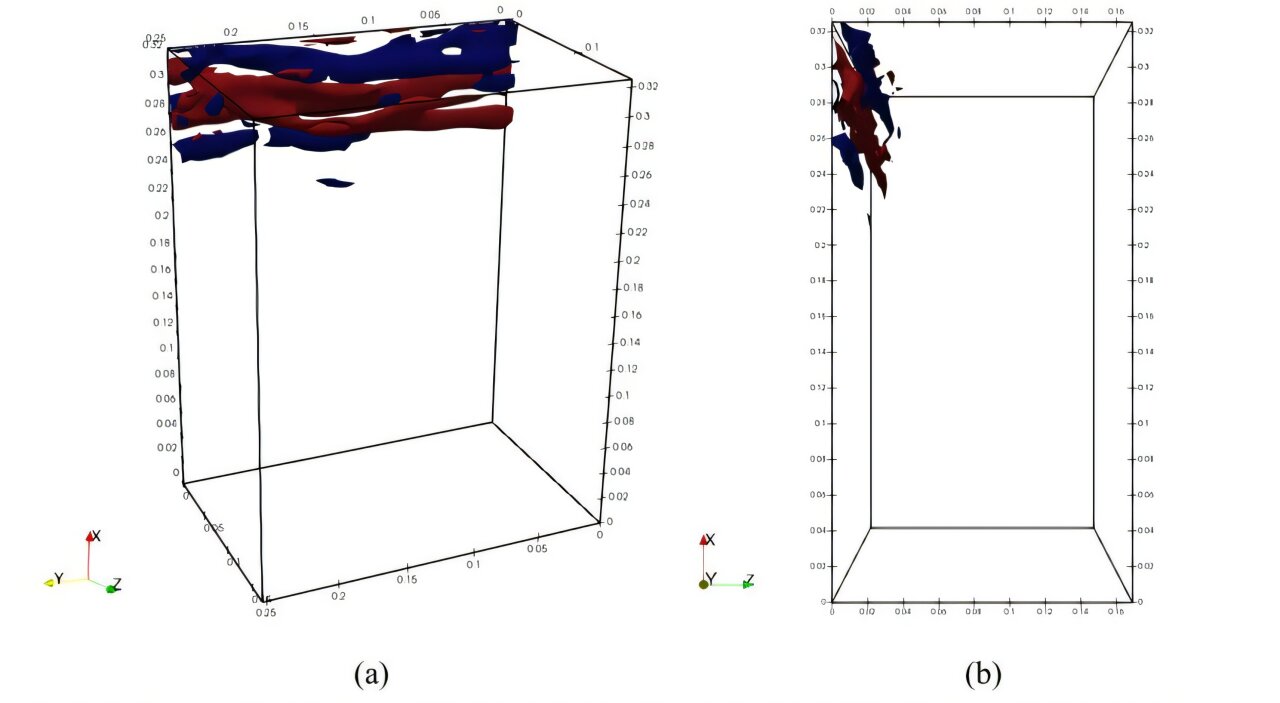
Heat transfer from a heated surface depends partly on the thin layer of air that warms and rises beside it. As this natural convection boundary layer develops, its flow can change from orderly patterns to turbulence, influencing heat transfer.
Observing its three-dimensional (3D) organization close to the surface is difficult: the wall blocks the multiple viewing directions required for volumetric optical measurements. Earlier experiments largely captured point measurements or two-dimensional slices; near-wall structures have often been examined through simulations.
Addressing this challenge, first author Shogo Ogasawara conducted the research in Takuma Kogawa's laboratory at the National Institute of Technology, Hachinohe College, Japan, in collaboration with Dr. Masahito Akamine from the Department of Aeronautics and Astronautics, The University of Tokyo. Kogawa is now an associate professor at the College of Engineering, Shibaura Institute of Technology, Japan.
The team adapted the mirror-assisted three-dimensional background-oriented schlieren framework proposed by Akamine and colleagues in 2023 to measurements of a natural convection boundary layer along a heated vertical wall.
The researchers used a mirror-finished aluminum plate, 12 synchronized cameras and two 4K display monitors showing random-dot patterns. By comparing consecutive synchronized images acquired after the wall temperature had stabilized, rather than using an unheated reference image, they suppressed much of the quasi-steady optical distortion caused by heat-induced wall warping. The images were separated by 33.3 milliseconds.
Their findings were published in International Communications in Heat and Mass Transfer .
Source link