

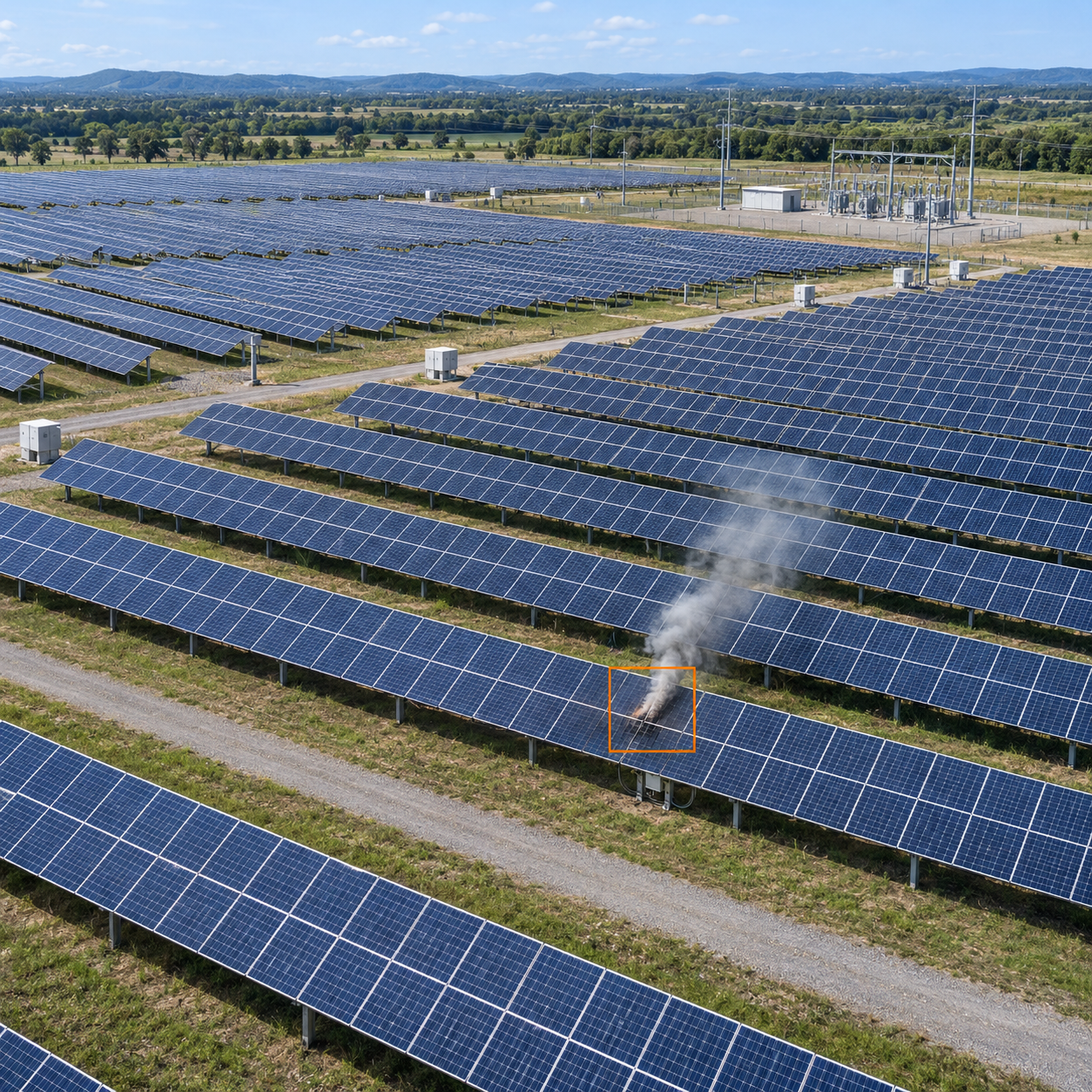
A research team from Chinese state-owned utility China Huaneng Group has developed a new deep-learning framework for real-time fire and smoke detection in PV power plants.
Dubbed PVFire-YOLO, the system is designed to detect small flames and smoke plumes while reducing false alarms caused by sunlight reflected from PV module surfaces.
“For the specific domain of PV inspection, deep-learning research has concentrated on three problems: electroluminescence (EL) crack detection, infrared (IR) hot-spot localization, and panel-level visible-light anomaly detection such as surface defects and soiling,” the researchers said. “Fire detection in PV environments has, by contrast, received almost no dedicated treatment.”
The researchers said they compiled the first annotated flame-and-smoke dataset specifically designed for PV environments.
“The new annotated corpus, PV-Fire, combines surveillance and unmanned aerial vehicle (UAV) imagery from operating utility-scale plants with controlled outdoor burns staged among real PV modules,” they added.
The proposed method is based on the YOLOv12 real-time object detection model and incorporates three additional components to improve fire detection in PV environments. A patch-aware attention block enhances weak flame and smoke features, while a gather-and-distribute mechanism combines information across four feature levels. An adaptive fusion head adds a high-resolution detection branch to identify small targets.
The researchers assembled the PV-Fire dataset, comprising 5,824 images with 9,107 annotated flame and smoke objects. The dataset combines surveillance and drone imagery, controlled outdoor burns, and synthetic images. They allocated 4,070 images for training, 870 for validation, and 884 for testing. They also separated scenes across the three subsets and restricted synthetic images to the training set.
Source link





