This article has been reviewed according to Science X's editorial process and policies. Editors have highlighted the following attributes while ensuring the content's credibility:
Gel polymer electrolytes (GPEs) are promising materials for developing high-energy-density lithium metal batteries. However, conventional polymer materials often have high crystallinity, which limits ionic conductivity (IC) and the Li⁺ transference number (tLi⁺). They can also cause high interfacial resistance and uncontrolled lithium dendrite growth, making room-temperature battery operation challenging.
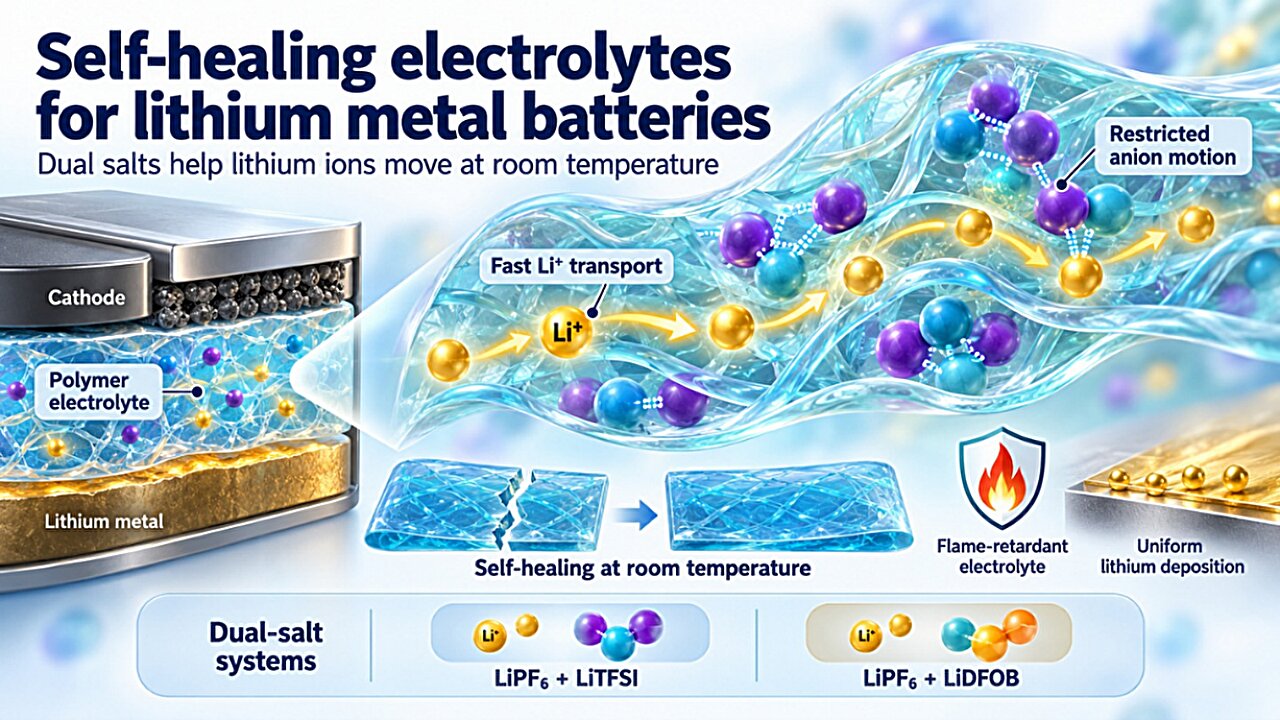
In Advanced Functional Materials, researchers introduce a dual-salt strategy into a self-healing polymer electrolyte to overcome these limitations. The interactions between the two salts help restrict anion movement within the polymer network, allowing more Li⁺ ions to participate in charge transport.
At the same time, interactions between the salts and polymer improve ion transport, resulting in an ionic conductivity of 2.23 mS cm⁻¹ and a Li⁺ transference number of 0.55. The electrolyte enables stable lithium plating and stripping in Li||Li symmetric cells for more than 2,000 hours.
In full-cell configurations, the LiFePO₄||Li cell delivers a capacity of 133 mAh g⁻¹ at 1C and retains 75% of its initial capacity after 700 cycles, while the NMC811||Li cell delivers 135 mAh g⁻¹ and maintains 72% capacity retention after 250 cycles.
Moreover, the electrolyte exhibits flame-retardant properties and promotes uniform lithium deposition, effectively suppressing dendrite growth.
"Overall, this dual-salt strategy offers a promising approach to developing room-temperature self-healing gel polymer electrolytes with improved battery performance, enhanced safety and reduced dead lithium formation," says co-corresponding author Chih Wei Chu, a research fellow at the Research Center for Applied Sciences, Academia Sinica, and the Institute of Applied Mechanics, National Taiwan University.
Source link