This article has been reviewed according to Science X's editorial process and policies. Editors have highlighted the following attributes while ensuring the content's credibility:
It's hard to ignore the difference: You can fill a car's tank with gas in mere minutes. Charging the battery of an electric vehicle (EV) can take 30 minutes or more.
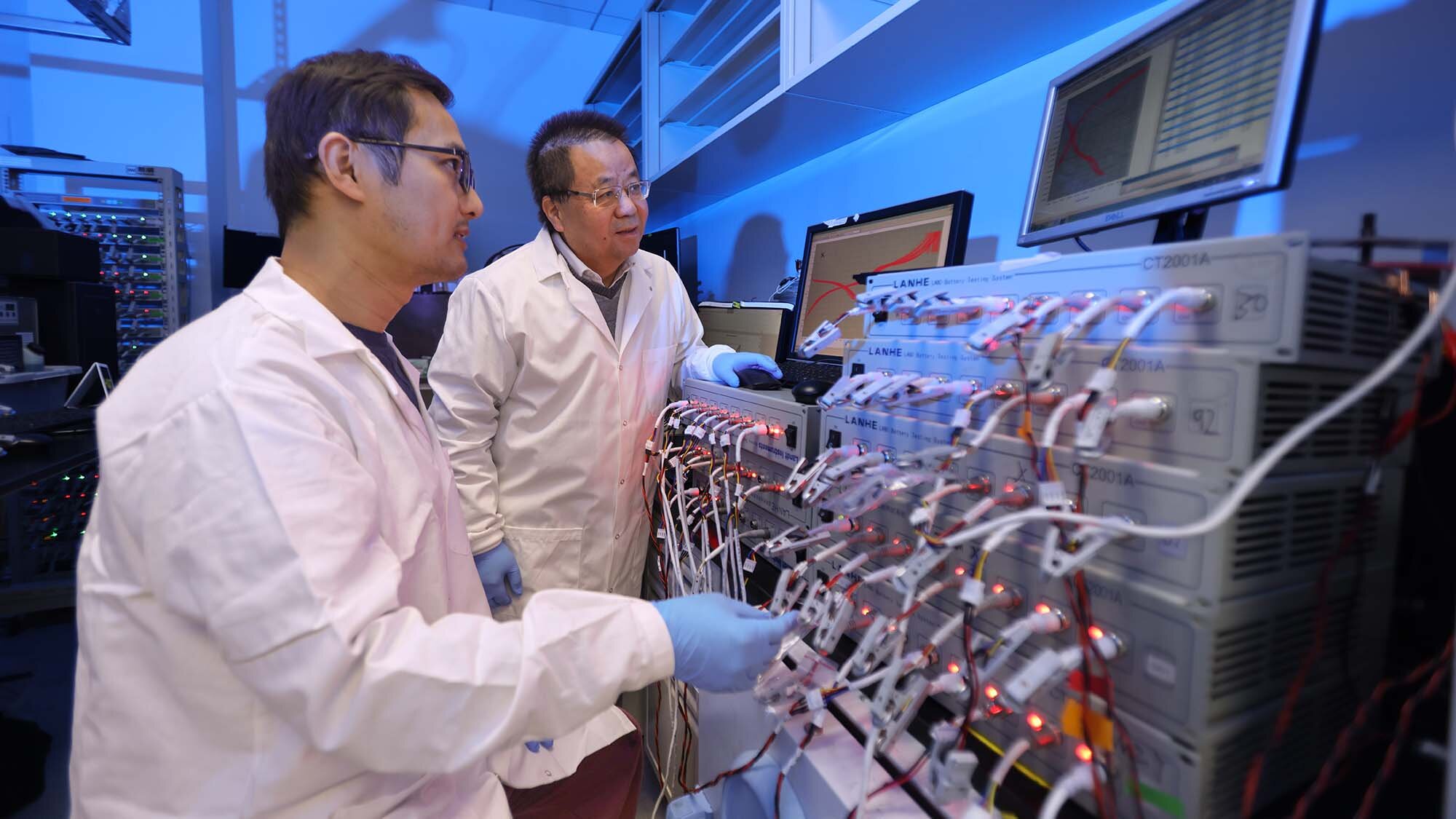
Chunsheng Wang, a distinguished university professor of chemical and biomolecular engineering at the University of Maryland, and his team are working to shorten that time—a critical step toward shifting from the dominance of fossil fuel–powered vehicles to cleaner, more efficient electric ones.
"If you want to compete with the gasoline engine, you have to have a similar charge time for the battery," Wang says.
The U.S. Department of Energy (DOE) is calling for the development of EV batteries that charge to 80% in less than 15 minutes. Wang and Chang-Xin Zhao, a researcher in his lab, are working to exceed this goal by cutting charging time to as little as 10 minutes—what they refer to as "coffee time."
"By the time you finish your coffee, the vehicle is charged," Zhao says. "That's what we want to achieve."
Previous efforts to expedite charging have focused on changing the structure of the battery's electrodes, which inadvertently lowers the amount of energy a battery can hold—a problematic trade-off.
Wang's group is devising ways to sidestep this trade-off by focusing on batteries' chemistry. In research described in the journal Science , his team, which Zhao led, identified a limitation lurking in the electrolyte, the medium through which lithium ions travel when a battery is discharged or charged.
Source link