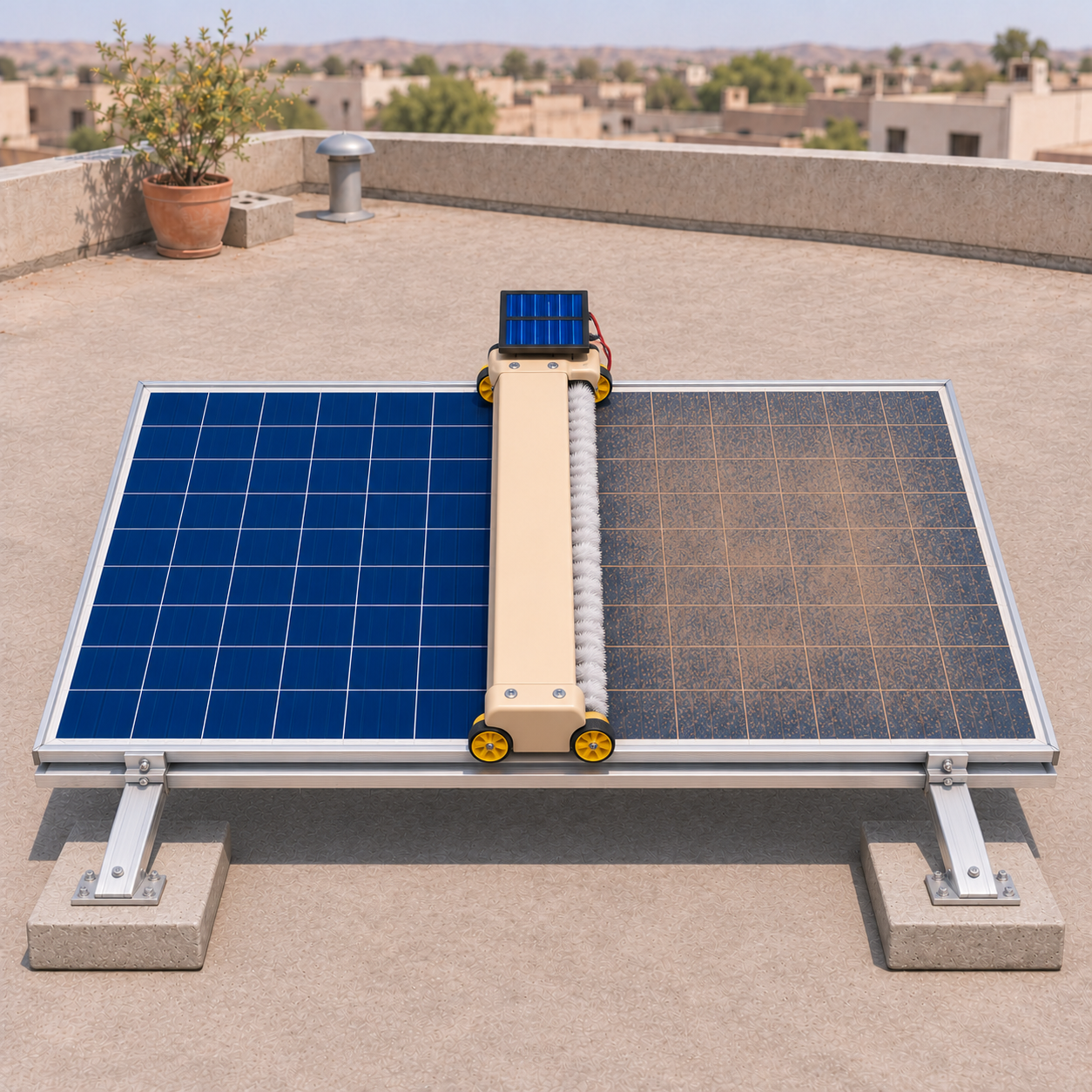
A research team from Pakistan and China has developed a self-powered robotic system for cleaning photovoltaic panels in water-scarce regions. The low-cost system uses commercially available, off-the-shelf components and costs approximately $64 to build.
“The proposed approach was validated through a three-month field deployment in Bahawalpur, Pakistan, a high-soiling desert environment,” the researchers said. “By directly coupling cleaning actions to recoverable energy losses and emphasizing affordability, autonomy, and field validation, this work advances a practical framework for PV maintenance in water-scarce and resource-limited regions.”
The researchers built a prototype that uses two identical 5 V reference panels to determine when cleaning is required. A servo-driven wiper cleans one panel every 30 seconds, while the other accumulates dust. An ESP32 controller compares the panels’ voltages, with a difference of at least 2 V serving as the primary cleaning trigger. The system also monitors airborne dust concentrations, using a threshold of 250 µg/m³, and prevents cleaning when the module temperature exceeds 45 C.
Once activated, the 7.6 kg robot travels along the length of the PV module, while a motor-driven nylon roller brush cleans its full width. Ultrasonic sensors detect the module edges, while a dedicated 20 W solar panel charges the robot’s 12 V, 3 Ah battery.
The researchers tested the robot on a single 180 W monocrystalline silicon module measuring 1,480 mm × 670 mm, installed at a fixed tilt angle of 28 degrees. They recorded sensor readings and operating data at one-second intervals during the three-month field trial, which included dust storms and intermittent rainfall.
Source link