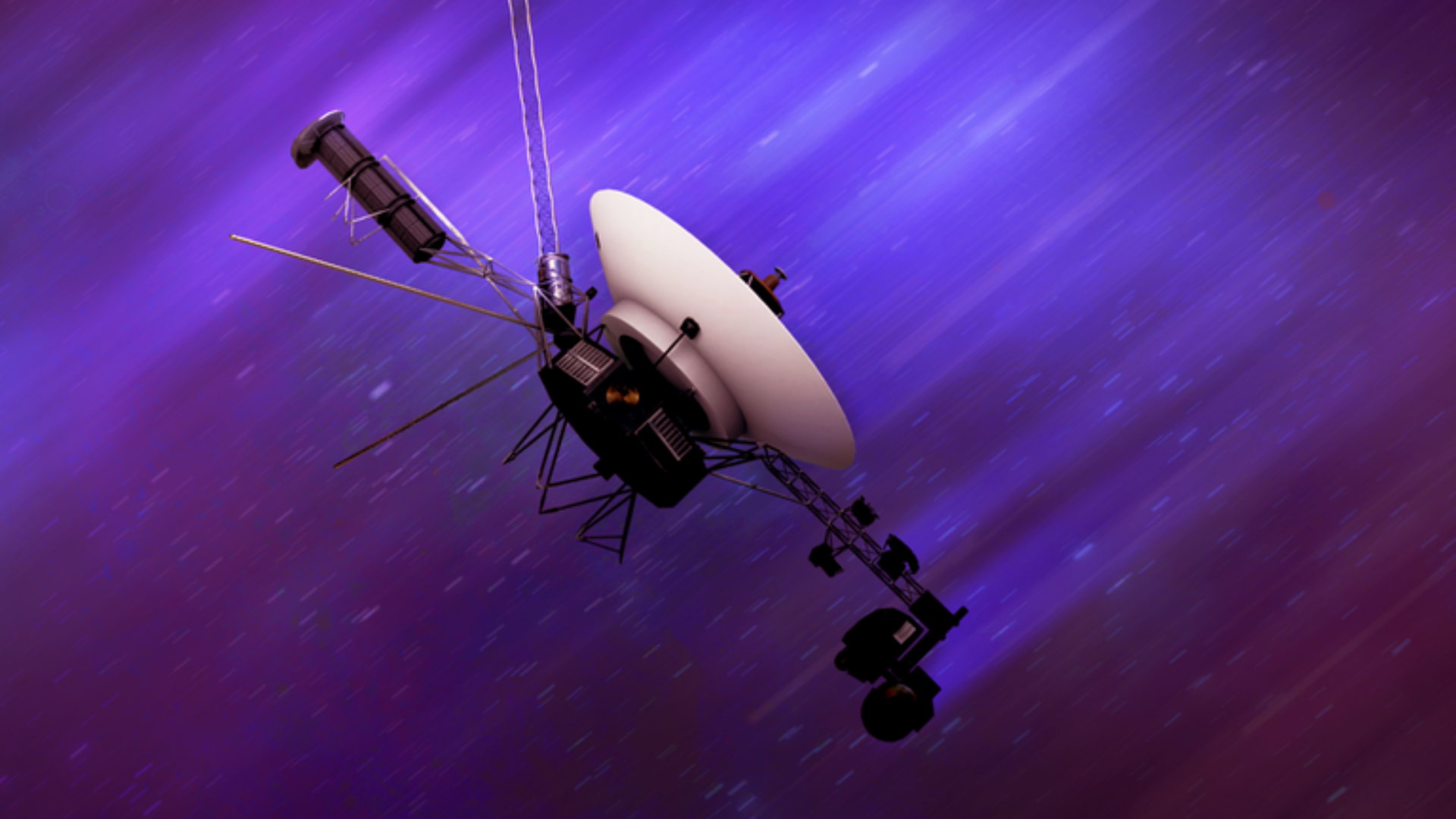
The Voyager 1 spacecraft, which was designed for a five-year mission to observe Jupiter and Saturn, is about to reach a distance of one light-day from Earth after nearly 50 years in flight. According to NASA, the space probe will get to that marker on Nov. 18, 2026, at 5:16:07 a.m. EST, making it the most distant artificial object in history. The agency has now posted a countdown clock to mark the historic moment it becomes the first human-made object to reach that distance.
One light-day isn’t a span of time, but the distance it takes for light to travel in 24 hours. Since light travels at around 186,282 miles per second or 300,000 km per second, that’s a distance of about 16 billion miles or 26 billion kilometers. By comparison, the Moon is 238,855 miles (384,400 kilometers) from Earth, while our planet is 93 million miles (149.6 million kilometers) from the Sun.
Voyager 1’s estimated speed in relation to the Sun is 37,844.49 mph, which makes it pretty fast (but still not the fastest human-made object ever built — the Parker Solar Probe’s holds the record at 394,736 mph). Despite that, it will still take the spacecraft 49 years, 2 months, and 13 days to get to one light-day from Earth.
This is actually one of Voyager 1’s achievements, as NASA scientists have extended its lifespan by nearly ten times the length of its original mission timeline. It also hasn’t been easy for the space probe — in 2024, it suffered from a critical memory error , which engineers were able to fix after weeks of diagnosis .
Source link