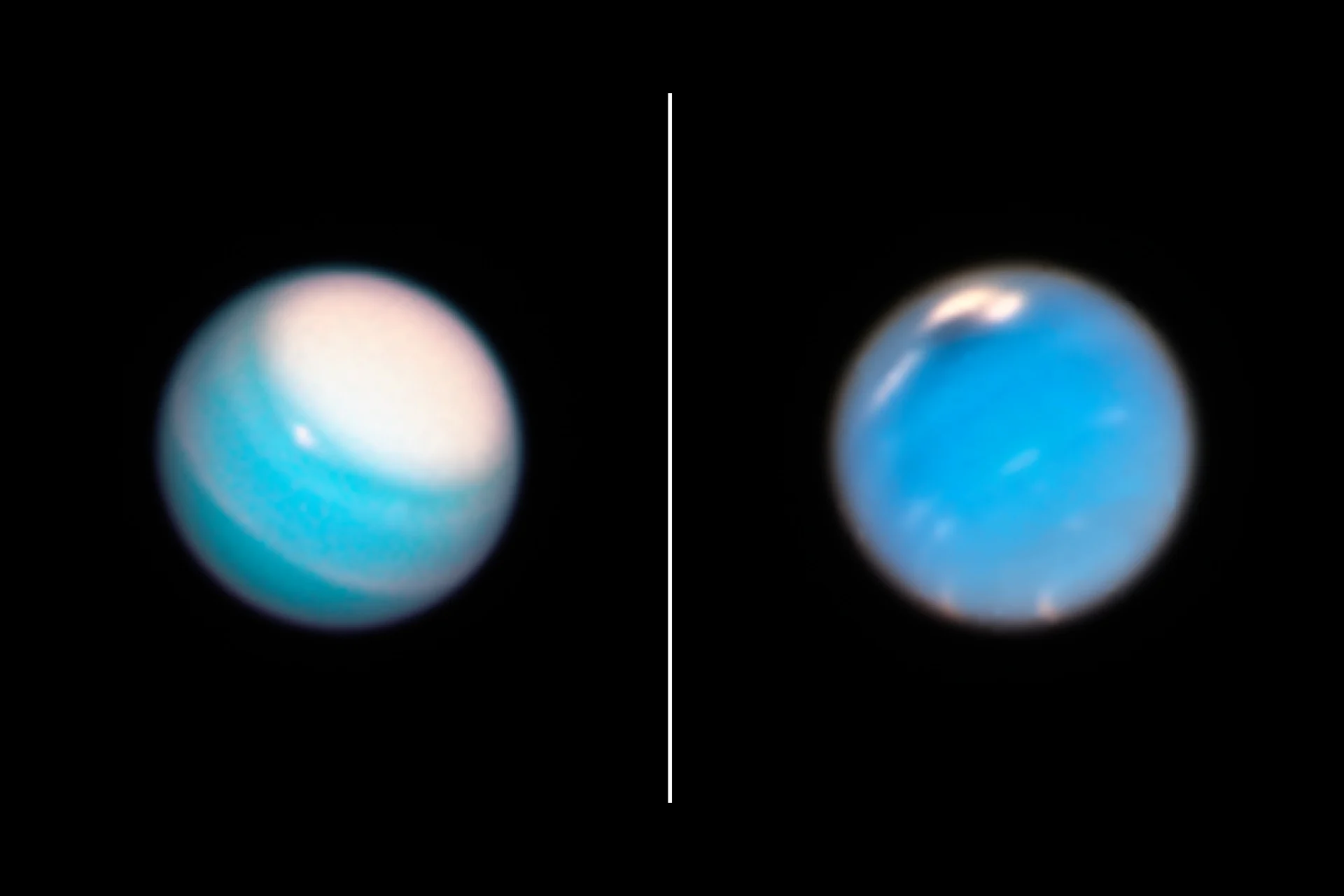
Despite the iconic documentary, Uranus and Neptune are arguably the real “blue planets” in our solar system. And their visual similarities in part convinced astronomers that they were evolutionary and chemical twins—but looks can deceive, as a new study has found.
In short, the similarities we observe today between Uranus and Neptune may be a coincidence, according to research published in Astronomy & Astrophysics. Studying recent measurements of carbon monoxide revealed that Neptune’s deep atmosphere has more oxygen than that of Uranus. Using this information, the team ran models to track regions of the protoplanetary disk—a rotating “platter” of gas and dust that forms planets—that birthed Uranus and Neptune. Surprisingly, the analysis strongly suggested that Uranus and Neptune weren’t from the same section of the protoplanetary disk, which would also give them different chemical origins.
“Uranus and Neptune may resemble twins today, but their chemistry is telling us that they are more like cousins with very different histories,” Olivier Mousis, the study’s co-author and a planetary scientist at the Southwest Research Institute, said in a statement. So their similarities today actually point to a “noteworthy coincidence,” he added.
” For astronomers, this means that Uranus and Neptune serve as the best (local) reference sheet for studying foreign planetary systems. But nature hasn’t been so generous in giving up its secrets. According to the paper, Uranus and Neptune have long heliocentric distances and low temperatures, which “severely limit” astronomers’ ability to study them. The ice giants are also enveloped in thick clouds and gases that not even the best radio telescopes can reliably pierce through, the team added.
Source link