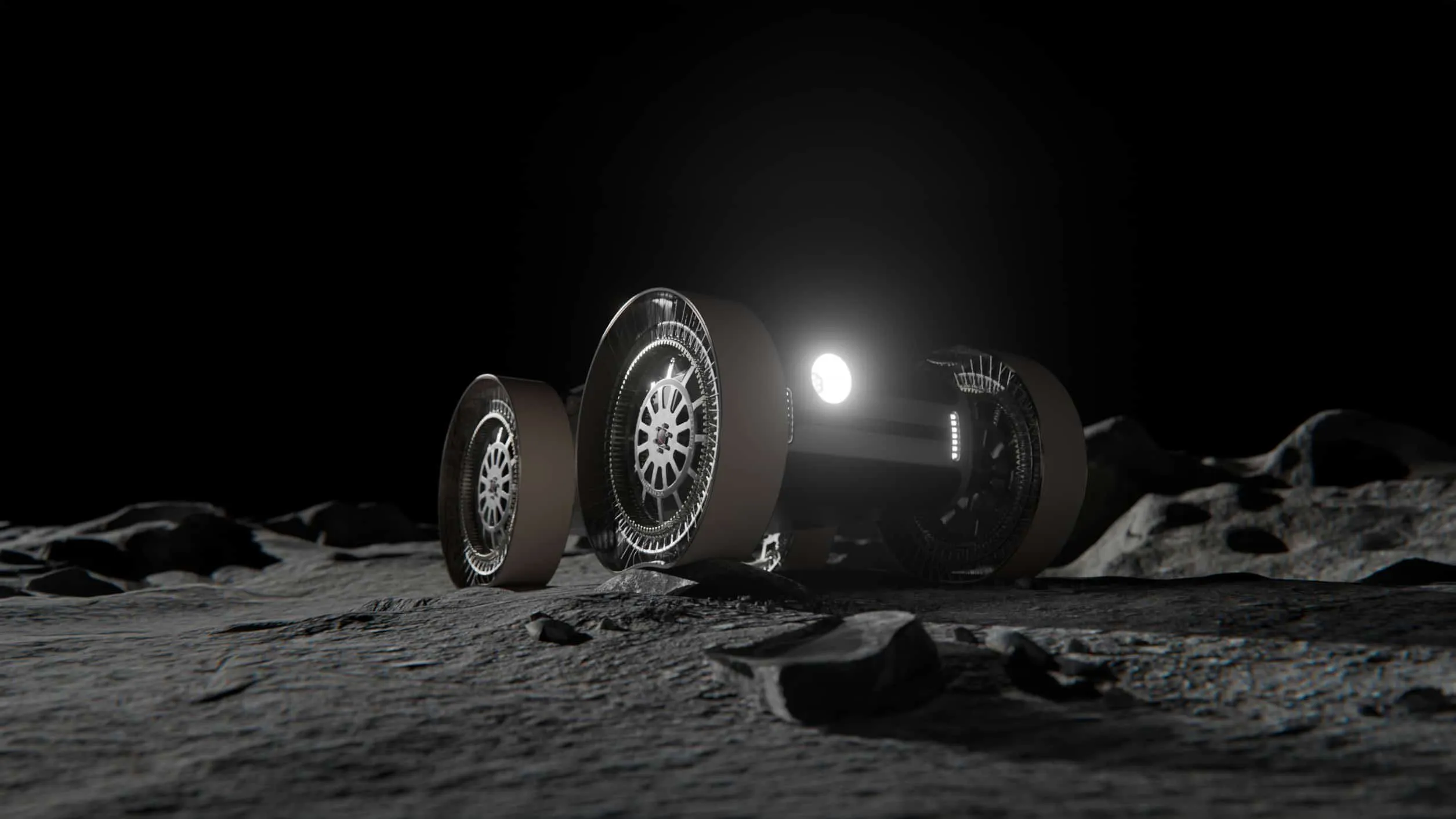
Large language models are set to go lunar. A computer capable of running AI software is one of the payloads aboard Astrolab’s FLIP lunar rover, which is slated to head to Earth’s celestial companion as early as November 2026.
The 480-kilogram FLIP rover, short for “FLEX Lunar Innovation Platform,” is the first in a series of vehicles NASA’s contracted from Astrolab, including future buggies that will move Artemis astronauts across the moon’s surface. Fitted with deformable wheels engineered for the rugged terrain and designed to survive at least 150 hours of the frigid lunar night, FLIP will carry 20 scientific payloads including a lidar 3D mapper and a sensor to measure concentrations of the isotope helium-3 in lunar regolith.
The rover will also carry a high-performance computer made by HPE that will be the first to run LLMs on the moon’s surface. Such software could ultimately help enable greater autonomy and real-time intelligent decision-making in space on future missions, eliminating the time delays and limited bandwidth that often plague long-distance communications between ground control on Earth and robots elsewhere in the solar system.
“The time delay, for example, on Mars can be up to 20 minutes,” Mark Fernandez, the chief scientist and principal investigator at HPE, said during a press conference introducing the project. “On the moon it’s reduced, but still, you are looking at stale data. In fact, the Soviets lost two rovers in the past because of operator errors caused by the time delay.”
During FLIP’s mission, specialized custom-built LLMs will run a series of experiments to prove that the technology can operate reliably in the extreme environment of the moon.
Source link